Cre8
Sparking creativity in everyday moments
Overview
🏆 Awarded “Most Innovative and User-Centric Solution” @ UXL Designathon '23
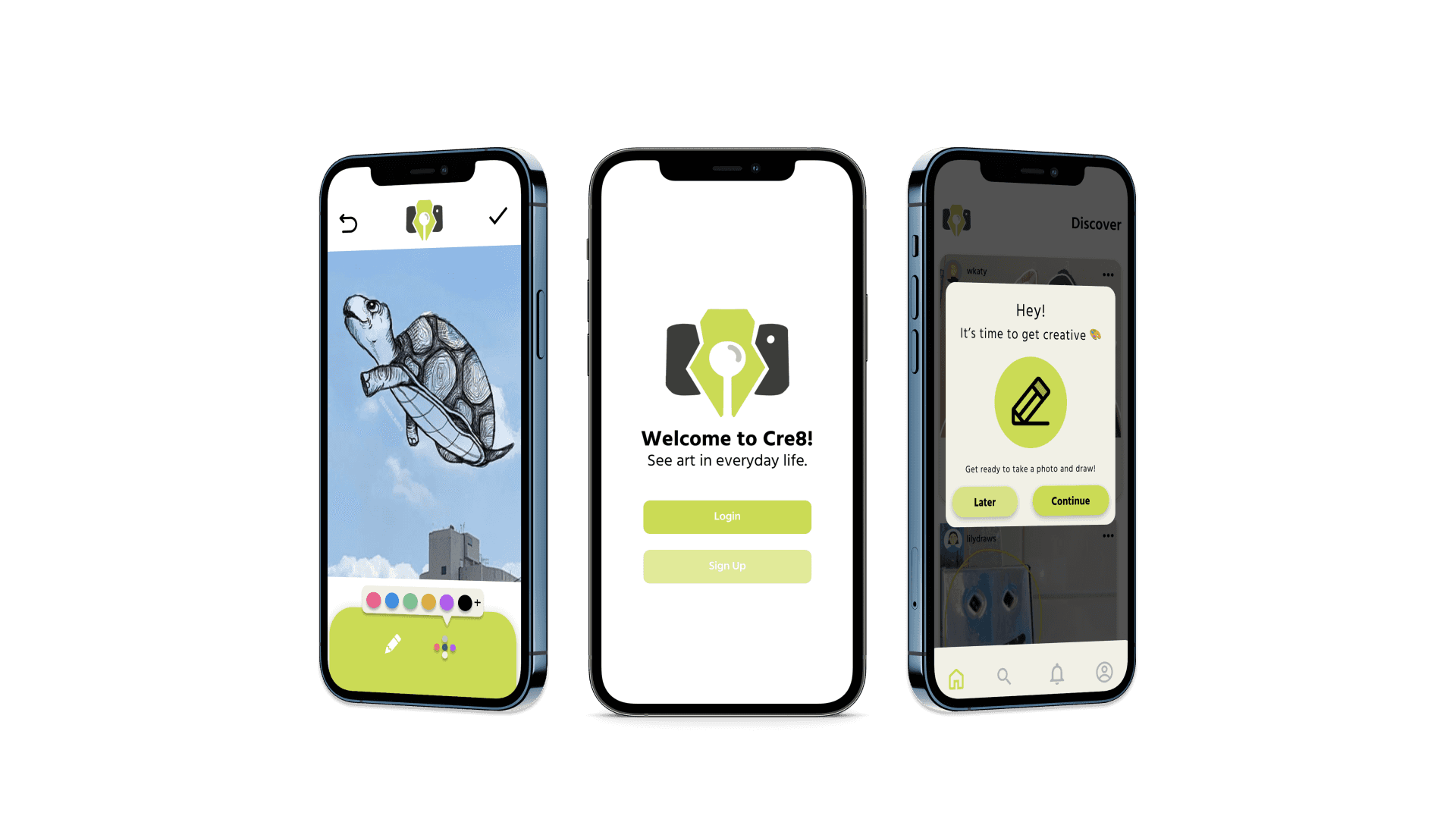
Cre8 is a mobile drawing app that invites adults to take mindful, creative breaks by sketching directly on photos from their surroundings. One daily prompt. One photo. A few minutes of drawing. No pressure to perform, no audience to impress.
Context
We lose curiosity as we grow up
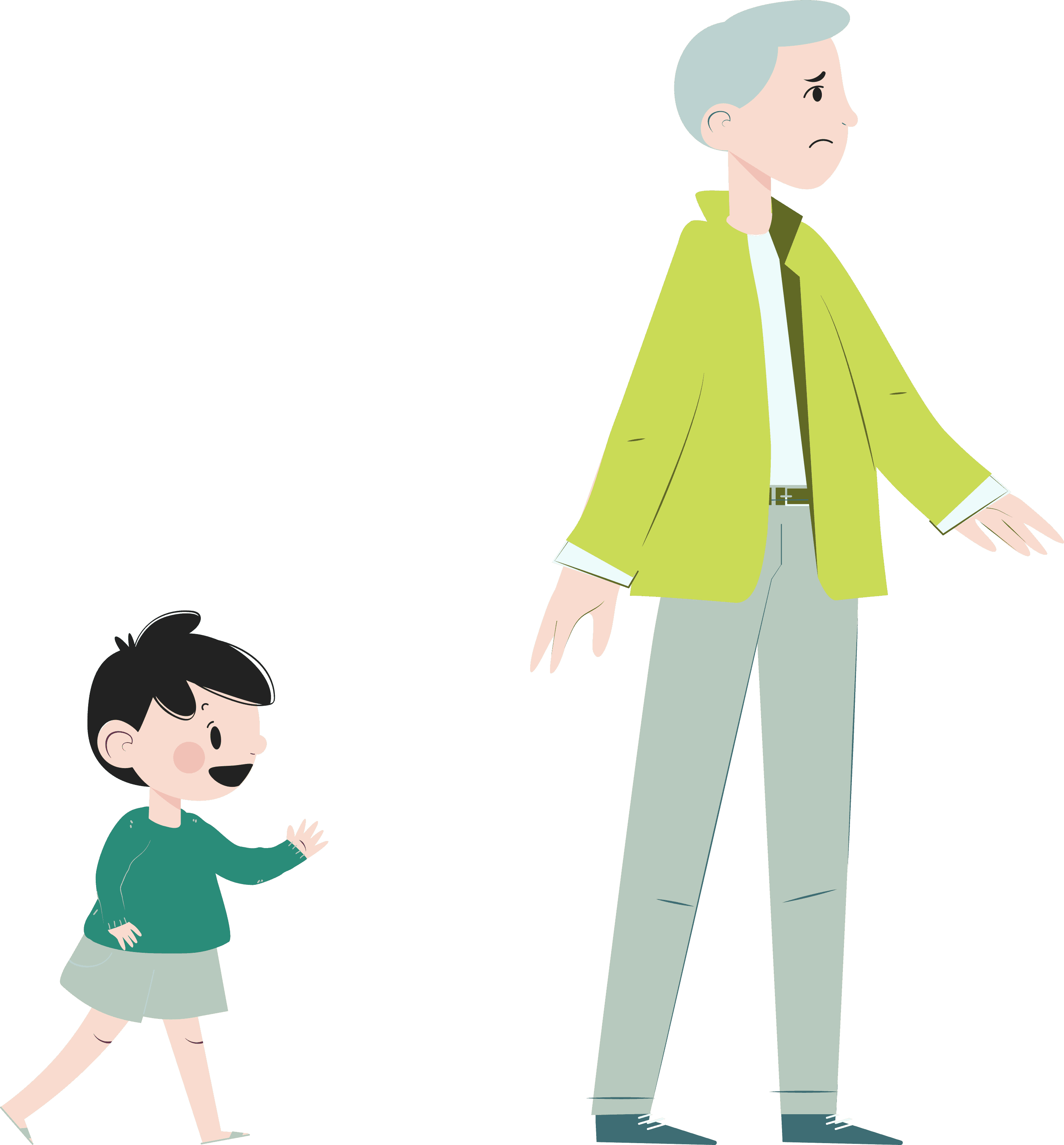
Have you ever watched a child explore their environment with wonder and curiosity? They're like little scientists, always testing and experimenting, eager to learn about the world around them.
As adults, we often lose touch with that sense of wonder and curiosity. But when it comes to children, fostering that sense of exploration is essential for their growth and development. We can explore unknown territories, find comfort in unfamiliar places, build new relationships, discover hidden passions and talents, and so much more.

Scope of the challenge
During this 48 hour designathon, our challenge was to design a solution that could help busy adults reconnect with their childhood spark. Our ideation stayed within what we could realistically prototype in 48 hours. We avoided backend-heavy features and focused on simple, demonstrable interactions that fit within Figma’s capabilities.
Problem statement
How might we re-connect with our own inner child, where curiosity grows and learning never stops?
As our schedules fill and routines take over, moments for creativity and reflection fade. Many adults struggle to pause, observe, or engage with the world around them beyond productivity.
Solution
Introducing
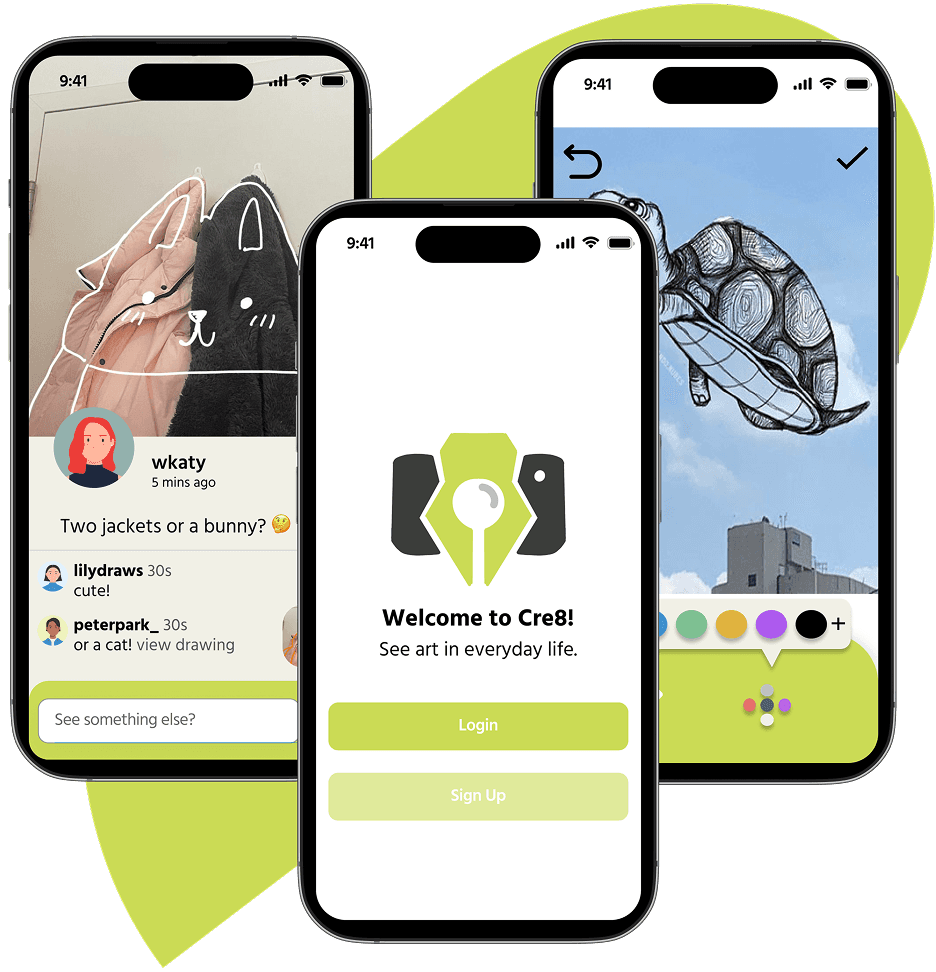
Ever spotted a creature hiding in the shadows as you drifted off to sleep? Or a face in the clouds overhead? Cre8 brings back this childhood magic, inviting you to draw everyday and rediscover imagination in the world around you.
Draw on what you see
Turn everyday moments into creative expression by sketching directly on photos from your surroundings.
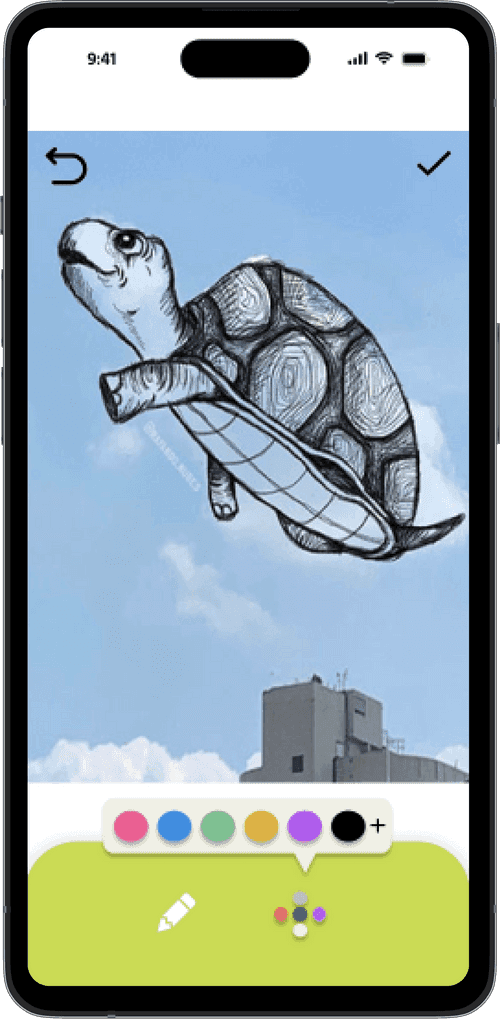
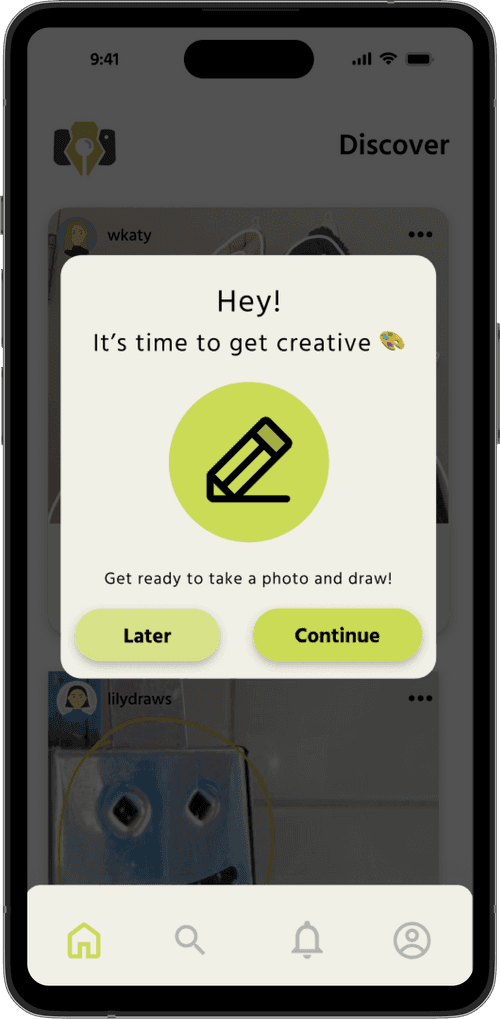
Take mindful breaks
Receive gentle daily notifications to pause, observe, and let your imagination wander.
Get inspired with AI
Discover personalized prompts and creative suggestions powered by AI to spark new ideas.
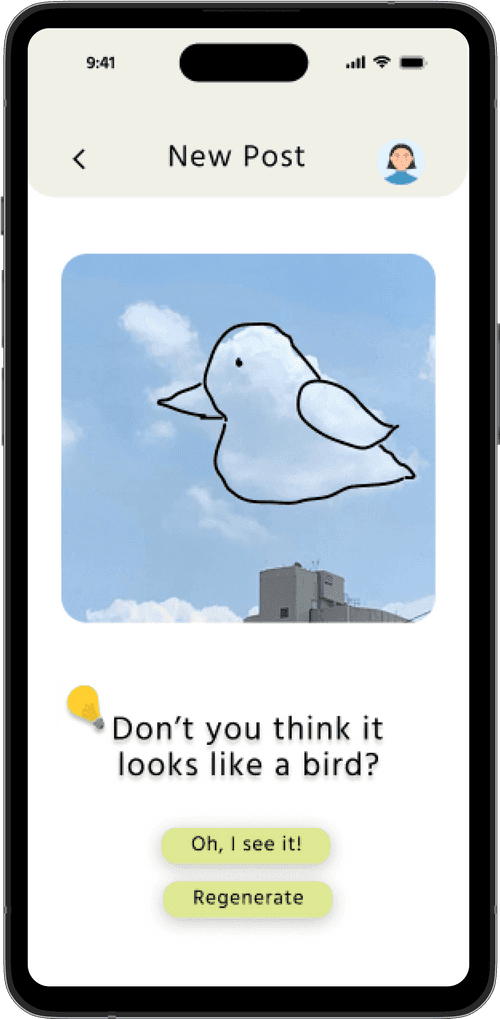
Connect through creativity
Share your drawings, see others’ perspectives, and build a community around everyday imagination.
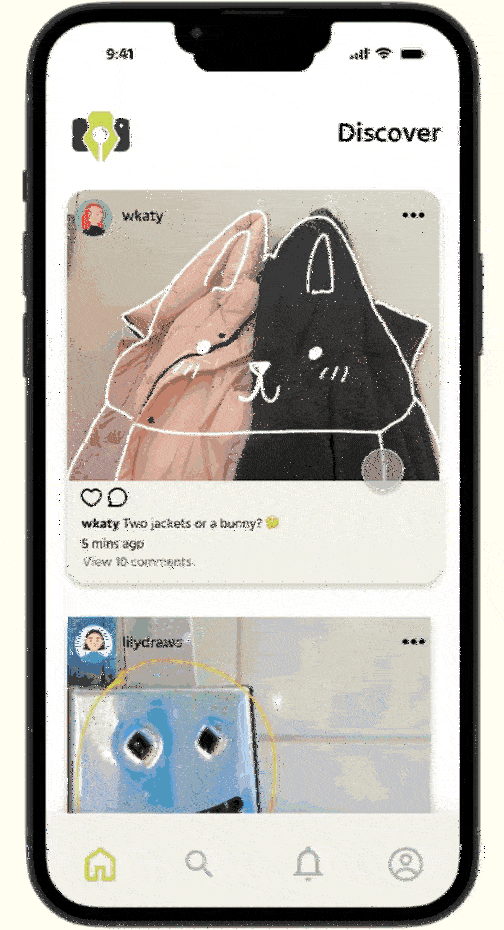
Connect with other users
View others' drawings for the day and add you drawing to their comments if you see something else in their picture!
Prototype
Explore Cre8
Interact with the prototype below!
Interact with the prototype below!
Interact with the prototype below!
Empathize — Primary research (survey)
Productivity culture killed the creative break
We surveyed 20 participants aged 18–35 to understand how burnout was affecting creativity habits. The results were starker than we expected.
In our survey we asked questions such as:
"Do you feel like your creativity has decreased as you grew older?"
"Have you ever felt burnt out due to work or school?"
"Do you have any idea what you want for your future? (e.g. career, life goals, etc.)
"Would you learn a new language or skill for fun if given the time?"
Key Findings
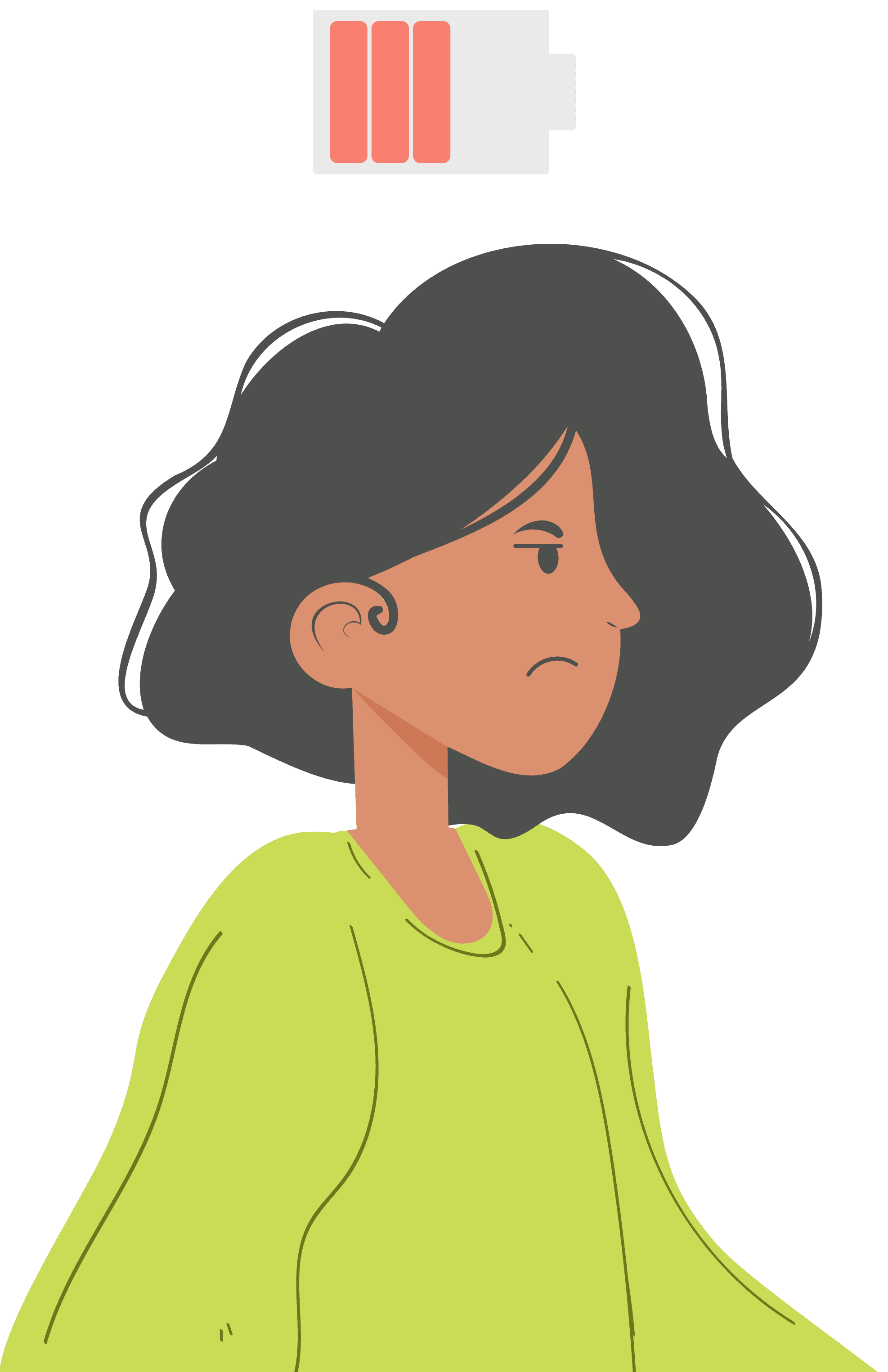
100%
of participants have felt burnt out from work or school.
>60%
of participants answered that their creativity may have decreased as they age.
For those who felt like their creativity has decreased with age, we asked them why and here's what we found:
"I think there are conceptual blocks (mental barriers) resulting from society that may prevent us from thinking creatively
"Lack of time. And building up disposable income to make time/space to do what creative things I want to do..."
"The feeling of burnout, the amount of criticism, feeling more nihilistic, learning more about reality"
Key Takeaways
1
Users need a way to escape burnout, especially during their busy schedule.
2
If given the time, users would take the time to learn a new skill even if it's unrelated to their current career.
3
Users have less opportunities to be creative as they grow up due to work, school or just reality.
4
Burnt out is a common feeling that working individuals deal with.
Define — Goals
What do we want to achieve with Cre8?
With our research in mind, we designed for students and working adults (ages 18–35) experiencing burnout and creative fatigue. Our goals were to make creativity feel more accessible and easier to fit into everyday life.

Make creativity feel low-pressure and playful
Reconnect adults with the sense of curiosity they had as a child.

Turn small moments into creative rituals
Encourage creativity in everyday life.

Support users' mental wellbeing
Provide a mindful break from stress and monotony.
Users don’t lack creativity, they lack time, energy, and tools that make creativity effortless and fun again.
Define — User personas
Meet Emily and Jose, two personas in different stages of the same burnout
To understand how burnout affects creativity, we developed two personas that reflected our research insights, representing both students and working professionals seeking balance and inspiration.

Emily, 20 | CS Student @ University of Waterloo
Goals & Motivations
Get a break from busy schedule
Reduce feeling of burn out by learning new skills in free time
Pain Points
Feels burnt out due to hectic school schedule
Gets bored with what she is currently learning in class
Feels drained from looking at social media constantly in her free time
How Cre8 helps Emily
Encourages curiosity and self-expression without deadlines or performance pressure
Replaces passive scrolling with active creation, helping her recharge mentally

Jose, 33 | UX Designer
Goals & Motivations
Rekindle his creativity for work projects
Learn a new skill outside of designing
Pain Points
Wants to learn new skills in his free time but feels tired due to busy schedule and projects
Feels burnt out at work which causes him to struggle to brainstorm new ideas
How Cre8 helps Jose
Makes learning feel restorative rather than demanding to reduce burnout after long workdays
Creates a low-stakes space for experimentation, brainstorming new ideas he can later bring back into his work
Define — Feature brainstorming
Brainstorming features to encourage creativity without friction
Building on our survey insights and personas, we mapped out potential features based on two criteria:
Would this make creativity easier for those lacking time?
Would this reduce or increase friction when users experience burnout?
This helped us separate features that supported effortless creativity from those that could overwhelm users or distract from mindful exploration.
Brainstormed features
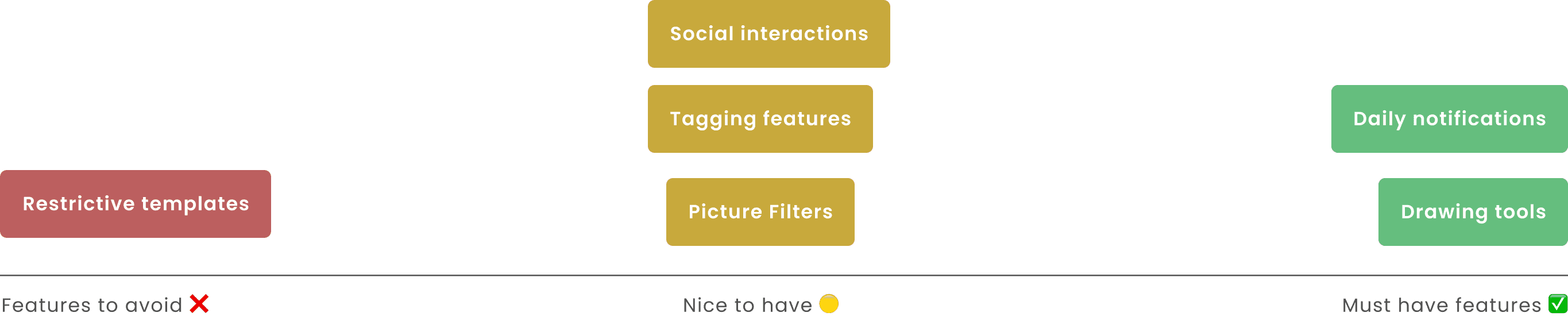
Features to avoid
These features introduced complexity and decision fatigue, which didn't align with our goal of making creativity feel simple.
Restrictive templates
Limited creative freedom and made drawing feel like a task rather than a playful break.
Nice to have
These features had potential value, but weren't central to helping burnt-out adults reconnect with creativity in micro-moments.
Social interactions
Browsing and light commenting to spark curiosity without pressure.Tagging features
Quick tags to help users discover patterns in what inspires them.Picture filters
Simple filters to make photos clearer for drawing without decreasing creativity.
Must have features
These features best aligned with users' needs for low-pressure, spontaneous creativity
Daily prompts (gentle notifications)
Not frequent reminders, just light cues to take a short, mindful pause.
Simple drawing tools
Quick, intuitive tools so users can sketch without setup.
Develop — Competitive anaylsis
The competitive gap: every existing app makes it worse
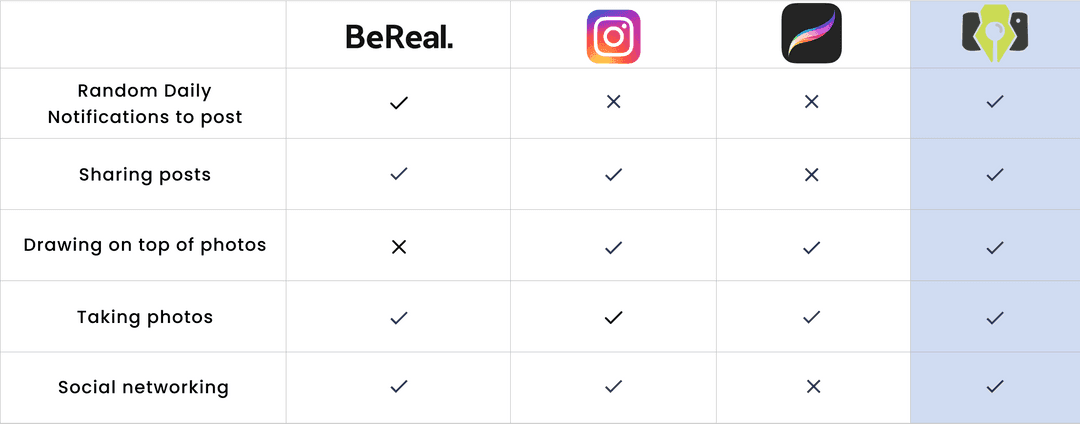
We mapped the creative and social platforms our target users already had on their phones, BeReal, Instagram, and Procreate and found that each one, in different ways, was actively contributing to the problem.
Key Insights
BeReal.
Daily prompts and authenticity framing, but no creative layer. Observation without expression.
Optimized for performance and comparison. Exactly the pressure our users were trying to escape.
Procreate
Powerful creative tools, but high barrier to entry and no daily ritual structure.
This gap highlighted an opportunity: designing for mindful creativity. Creating quick, low-pressure moments of self-expression that naturally fit into a busy schedule without adding more noise.
Develop — User flows
Mapping user flows to make creativity effortless
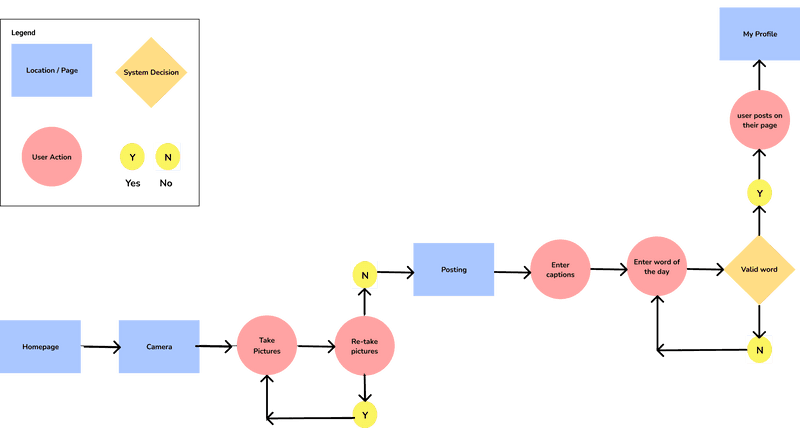
Our design prioritized simplicity, including a streamlined flow that reduces decision fatigue and lowers the barrier to creating. This structure reduced friction and transformed creativity from a chore into a simple daily ritual.
Eliminating friction to meet user needs
To reduce friction, we created a highly linear flow to directly address the pain points and motivations of our personas.
Pain point: Hectic schedule causing burn out and drained from looking at social media constantly.
Design solution: Flow minimizes System Decisions and unnecessary steps. This minimizes the mental effort needed and ensured the creative process doesn't contribute to decision fatigue.
Result: The linear flow allows users to get a break from their busy schedule without the task feeling like another chore.
Pain point: Feeling tired due to busy schedule and struggling to brainstorm new ideas when burnt out.
Design solution: The flow from "Camera" to "My Profile" is straightforward and action-oriented. This predictability provides a clear structure that serves as a gentle push and reduces cognitive load.
Result: Through an effortless process, creativity is rekindled with a reliable low-stress method for creative output. This alleviates the feeling of struggling with brainstorming.
Develop — Lofis
Sketching low-fidelity wireframes to shape the core experience
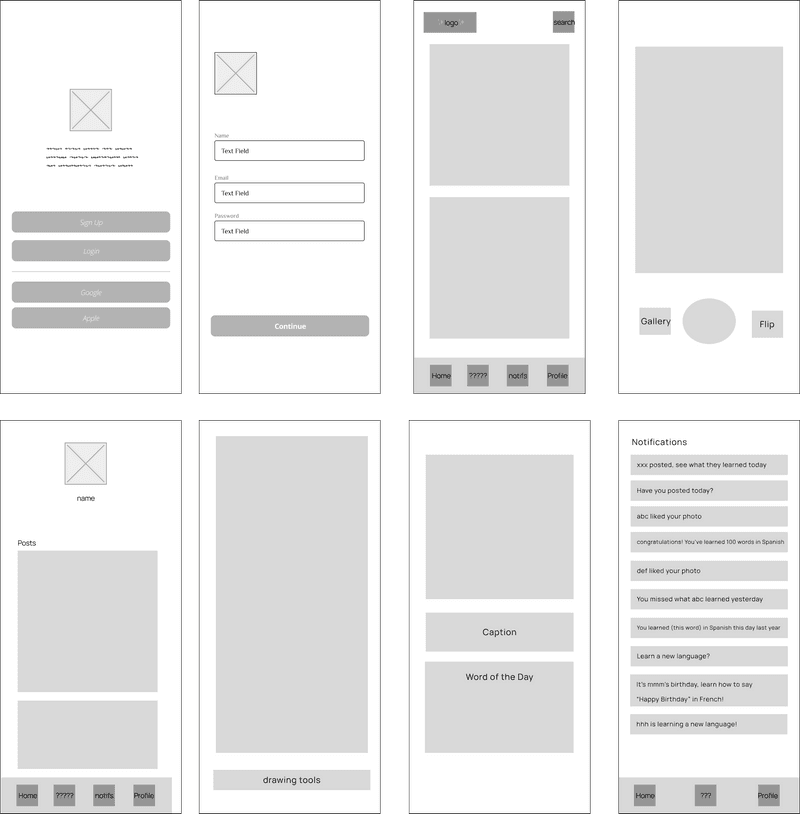
We began with low-fidelity sketches to visualize core interactions and content placement. These helped us test layout hierarchy and ensure accessibility early on. The focus was on function over form, establishing how users would move through the experience before defining its visual style.
Ensuring accessibility
To ensure our solution is accessible to a broad audience, we integrated accessibility features directly into the lo-fi structure. This included:
Large touch targets: Created button and interactive areas to meet minimum size standards.
Clear hierarchy: Included distinct sections for content to support screen reader navigation and reduce the cognitive load for burnt-out users.
Contrast: Laid out elements with clear separation to plan for high colour contrast when creating hi-fis.
Core functionality
Furthermore, the lo-fis validated the functionality needed to meet our personas' motivations.
Needs
What was solved?
Benefit
Emily: Need for efficiency/breaks
Quick, linear posting flow
Ensures the core task is completed with minimal clicks to make creativity low-friction.
Jose: Goal to learn a new skill and rekindle creativity
Dedicated, simple drawing tools
Provides an accessible way to express creativity and practice through daily drawings.
Both: Need for inspiration
Gallery and notifications tabs
Encourages curiosity and provides visual inspiration for users who struggle with brainstorming when burnt out.
Develop — Hifis
Refining high-fidelity wireframes with mentor feedback
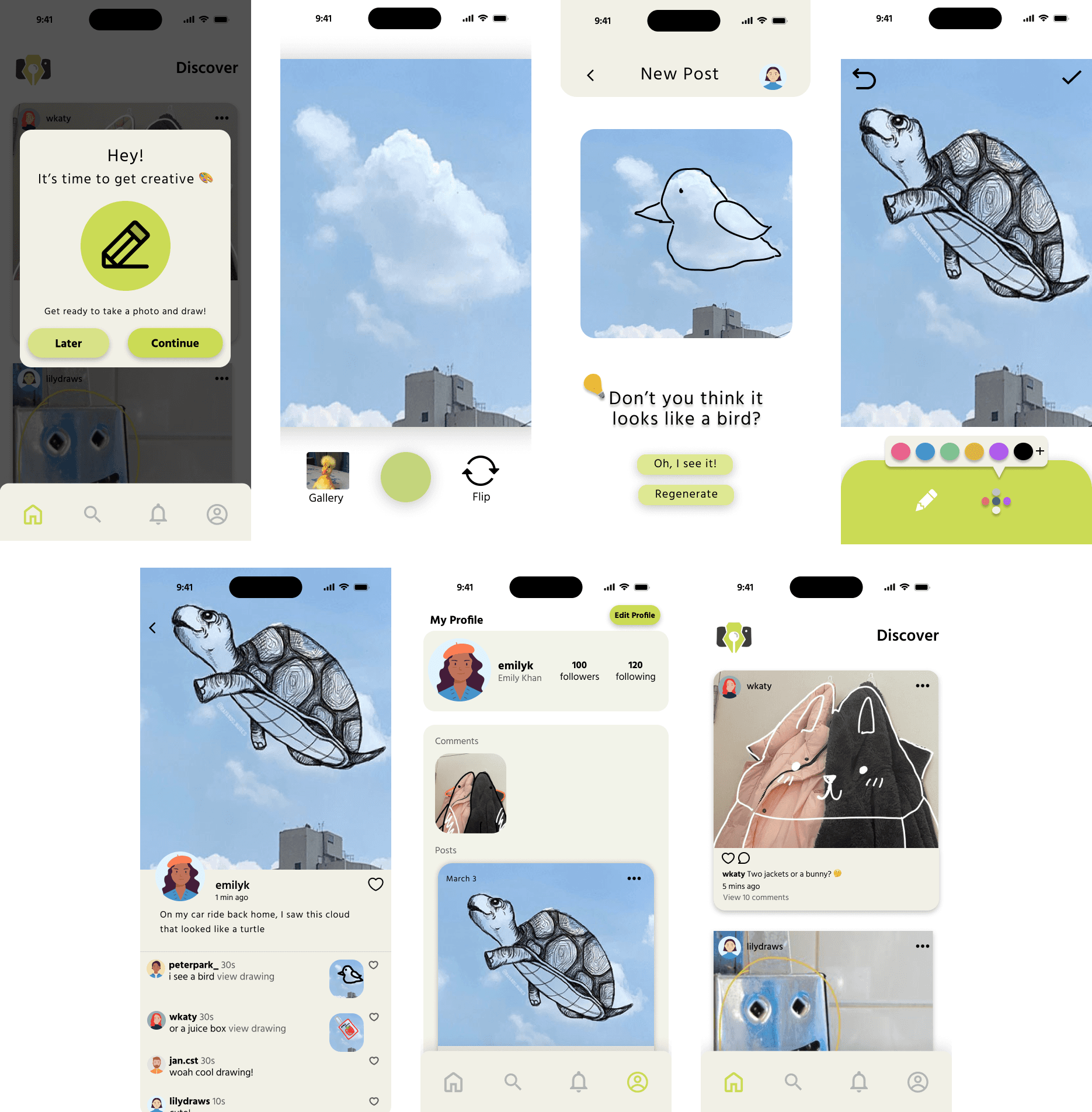
After validating the structure and feedback, I refined the designs into high-fidelity wireframes with color, typography, and interaction details. This stage brought the concept to life and prepared it for feedback during the designathon.
This initial structure was refined based on mentor feedback that led to three main changes that simplified the core concept, increased curiosity, and improved the creative canvas.
Revisions based on feedback
Simplifying features to strengthen the core concept
The initial design included a language learning component (translating a phrase) alongside the daily drawing.
Feedback: It seemed like it was just thrown in with no relation to the drawing idea. We should just stick to one idea as it is solid by itself and having the translation aspect may overwhelm the user.
Result: We narrowed down our app to only focus on the creative aspect and letting users unleash their creative side through daily drawings. This reduced friction and ensured the app serves its main purpose of providing a low-effort creative break.
Encouraging interaction to spark curiosity
In our original concepts, we focused too heavily on the core drawing experience with little emphasis on user-to-user interactions.
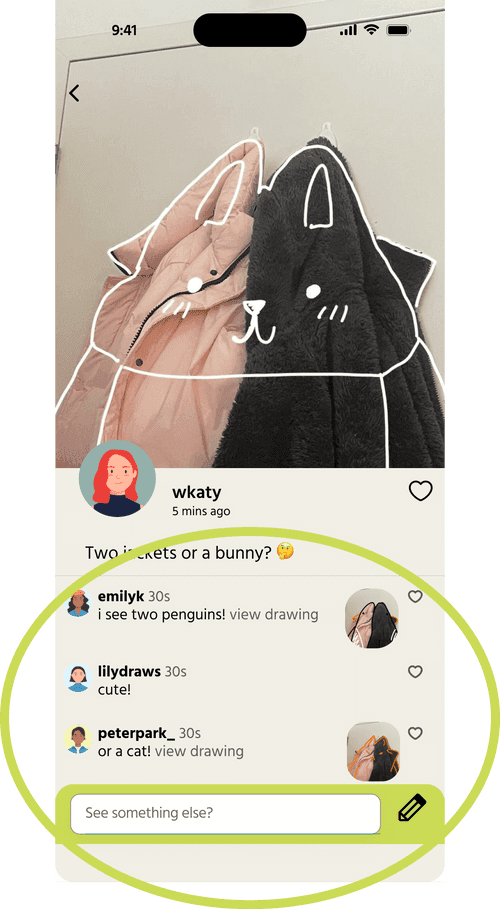
Feedback: Increasing user interaction can help spark curiosity between users rather than leaving it as a solo experience. Add features that let users connect, such as guessing others’ drawings or commenting on posts.
Result: We introduced curiosity-based interactions, commenting, guessing, and seeing different interpretations, to boost creativity and foster community. This made the app more engaging for users like Jose, who struggle with creative burnout and need external inspiration.
Introducing a blank canvas to inspire creativity
The initial color palette used a muted color for the main background.
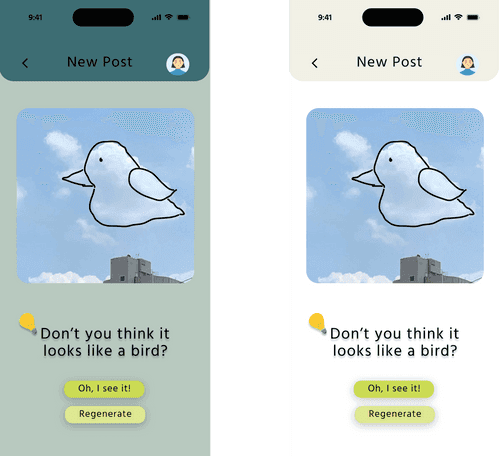
Feedback: Since it is a drawing app, white can be used to represent a blank canvas that users are able to draw on.
Result: We switched to white for our primary colour and the colours from our style guide as secondary colours. The interface became a more intuitive and inspiring blank canvas.
Final Designs
Onboarding & Homepage
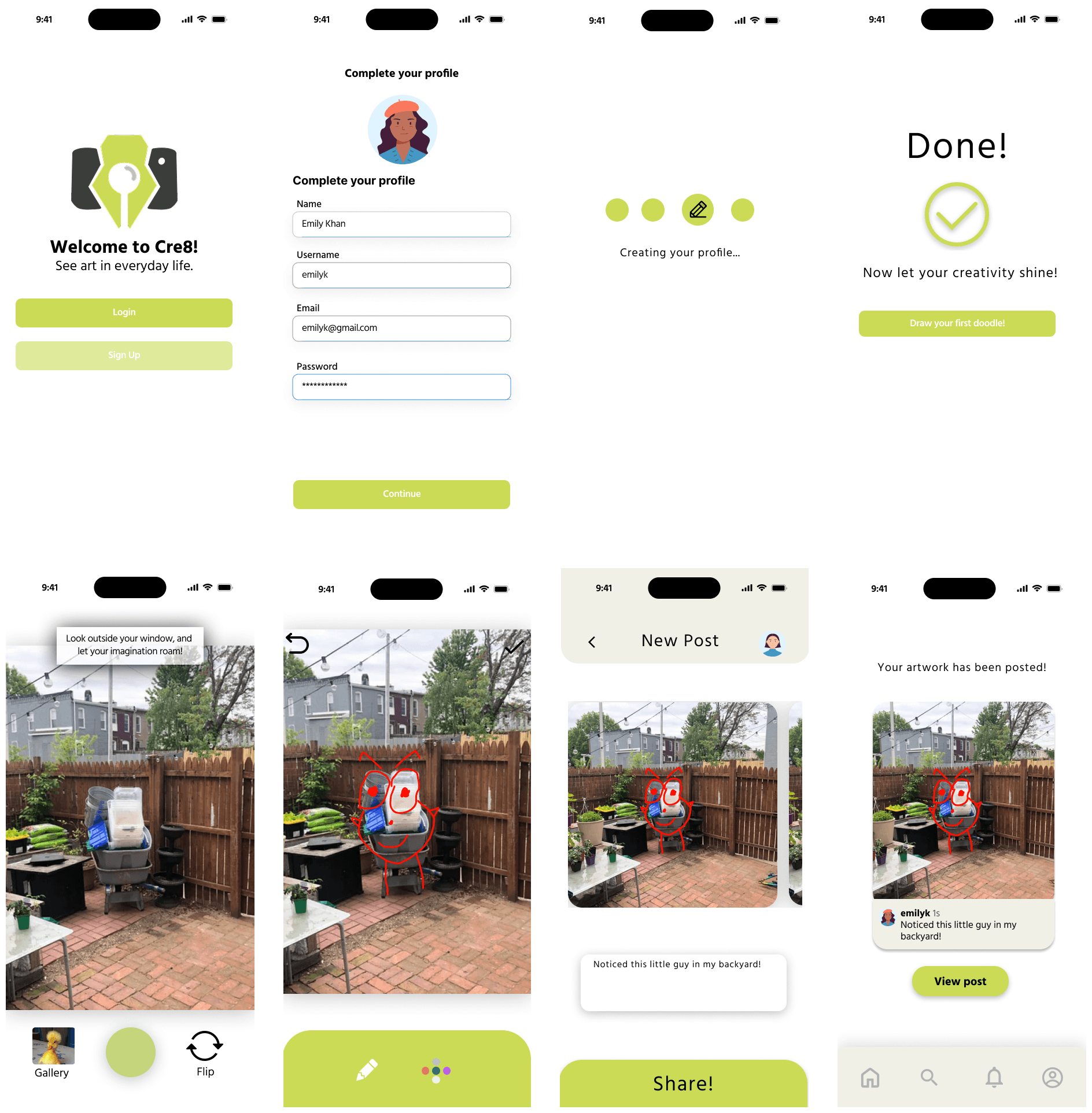
Networking & Profile
Deliver — Results
Cre8-ing an innovative and user-centric experience
I'm honoured to say that my team received the award for the Most Innovative and User-Centric Solution! 🏆
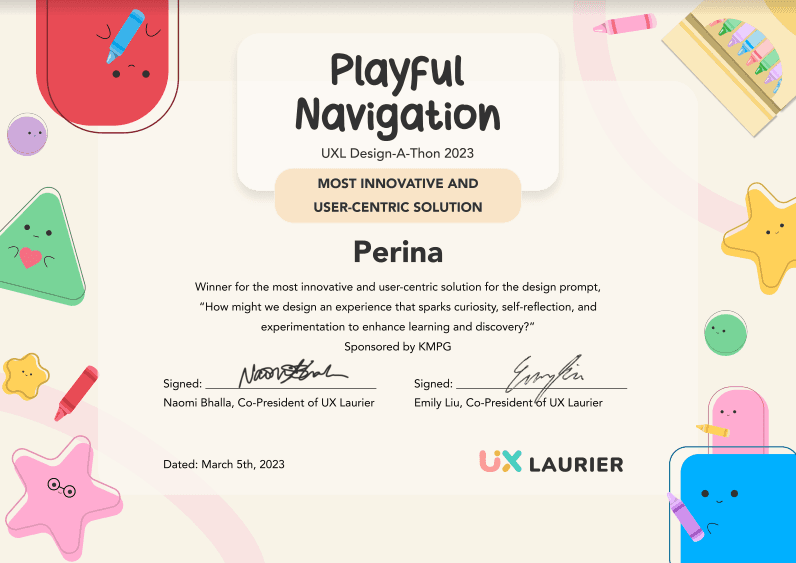
Although we didn't advance to the finals presentation round. The feedback we received affirmed what we'd been most uncertain about: the concept was genuinely novel and the design executed it with real user empathy.
What I learned
Key takeaways
Colour psychology isn't a finishing touch
The switch to white completely changed how the app felt. It became more open, more inviting, more like a place to create. That single decision had more impact on the user experience than hours of layout work. I think about visual mood earlier in the process now.
Simplicity is the hardest design decision
The instinct in a sprint is to add. More features, more polish, more differentiation. The best decision we made was to subtract: cut the language feature, simplify the flow, reduce the social layer to what was essential. The product got better every time we removed something.
Feedback is the design process
The three biggest improvements to Cre8 all came from mentor feedback during the sprint. Designing in a closed loop would have produced a worse product. I had to be willing to hear hard feedback and act on it immediately.
What I'd do differently
Test with users experiencing active burnout and not just users who recall it
There's a difference between designing for the memory of burnout and designing for the moment of it.
Revisit AI prompts feature
Judges flagged that AI-generated prompts might actually undermine creative agency, a problem we didn't fully resolve. It could be worth exploring a user-generated prompt system as an alternative.
Push the visual design further
The UI was functional but safe. Given more time, I'd have pushed the visual identity to feel as playful as the concept.
Personal reflection
Looking back on the designathon…
Overall, this was a rewarding experience! Getting the chance to work on a unique solution to an equally unique problem pushed me to think creatively and iterate with purpose. Receiving feedback throughout the process helped us to refine our ideas and strengthen our approach. I was able to learn a lot about balancing creativity with usability and further my skills as a designer.
Sometimes, the best ideas come from slowing down and simply… drawing what you see.
Thanks for checking out this case study! If you have any questions or want to know more, don't hesitate to contact me. While you're still here, please feel free to check out my other work or learn more about me. :)
Cre8
Sparking creativity in everyday moments
Overview
🏆 Awarded “Most Innovative and User-Centric Solution” @ UXL Designathon '23
Cre8 is a mobile drawing app that invites adults to take mindful, creative breaks by sketching directly on photos from their surroundings. One daily prompt. One photo. A few minutes of drawing. No pressure to perform, no audience to impress.
Context
We lose curiosity as we grow up
Have you ever watched a child explore their environment with wonder and curiosity? They're like little scientists, always testing and experimenting, eager to learn about the world around them.
As adults, we often lose touch with that sense of wonder and curiosity. But when it comes to children, fostering that sense of exploration is essential for their growth and development. We can explore unknown territories, find comfort in unfamiliar places, build new relationships, discover hidden passions and talents, and so much more.
Scope of the challenge
During this 48 hour designathon, our challenge was to design a solution that could help busy adults reconnect with their childhood spark. Our ideation stayed within what we could realistically prototype in 48 hours. We avoided backend-heavy features and focused on simple, demonstrable interactions that fit within Figma’s capabilities.
Problem statement
How might we re-connect with our own inner child, where curiosity grows and learning never stops?
As our schedules fill and routines take over, moments for creativity and reflection fade. Many adults struggle to pause, observe, or engage with the world around them beyond productivity.
Solution
Introducing
Ever spotted a creature hiding in the shadows as you drifted off to sleep? Or a face in the clouds overhead? Cre8 brings back this childhood magic, inviting you to draw everyday and rediscover imagination in the world around you.
Draw on what you see
Turn everyday moments into creative expression by sketching directly on photos from your surroundings.
Take mindful breaks
Receive gentle daily notifications to pause, observe, and let your imagination wander.
Get inspired with AI
Discover personalized prompts and creative suggestions powered by AI to spark new ideas.
Connect through creativity
Share your drawings, see others’ perspectives, and build a community around everyday imagination.
Connect with other users
View others' drawings for the day and add you drawing to their comments if you see something else in their picture!
Prototype
Explore Cre8
Interact with the prototype below!
Interact with the prototype below!
Interact with the prototype below!
Empathize — Primary research (survey)
Productivity culture killed the creative break
We surveyed 20 participants aged 18–35 to understand how burnout was affecting creativity habits. The results were starker than we expected.
In our survey we asked questions such as:
"Do you feel like your creativity has decreased as you grew older?"
"Have you ever felt burnt out due to work or school?"
"Do you have any idea what you want for your future? (e.g. career, life goals, etc.)
"Would you learn a new language or skill for fun if given the time?"
Key Findings
100%
of participants have felt burnt out from work or school.
>60%
of participants answered that their creativity may have decreased as they age.
For those who felt like their creativity has decreased with age, we asked them why and here's what we found:
"I think there are conceptual blocks (mental barriers) resulting from society that may prevent us from thinking creatively
"Lack of time. And building up disposable income to make time/space to do what creative things I want to do..."
"The feeling of burnout, the amount of criticism, feeling more nihilistic, learning more about reality"
Key Takeaways
1
Users need a way to escape burnout, especially during their busy schedule.
2
If given the time, users would take the time to learn a new skill even if it's unrelated to their current career.
3
Users have less opportunities to be creative as they grow up due to work, school or just reality.
4
Burnt out is a common feeling that working individuals deal with.
Define — Goals
What do we want to achieve with Cre8?
With our research in mind, we designed for students and working adults (ages 18–35) experiencing burnout and creative fatigue. Our goals were to make creativity feel more accessible and easier to fit into everyday life.
Make creativity feel low-pressure and playful
Reconnect adults with the sense of curiosity they had as a child.
Turn small moments into creative rituals
Encourage creativity in everyday life.
Support users' mental wellbeing
Provide a mindful break from stress and monotony.
Users don’t lack creativity, they lack time, energy, and tools that make creativity effortless and fun again.
Define — User personas
Meet Emily and Jose, two personas in different stages of the same burnout
To understand how burnout affects creativity, we developed two personas that reflected our research insights, representing both students and working professionals seeking balance and inspiration.
Emily, 20 | CS Student @ University of Waterloo
Goals & Motivations
Get a break from busy schedule
Reduce feeling of burn out by learning new skills in free time
Pain Points
Feels burnt out due to hectic school schedule
Gets bored with what she is currently learning in class
Feels drained from looking at social media constantly in her free time
How Cre8 helps Emily
Encourages curiosity and self-expression without deadlines or performance pressure
Replaces passive scrolling with active creation, helping her recharge mentally
Jose, 33 | UX Designer
Goals & Motivations
Rekindle his creativity for work projects
Learn a new skill outside of designing
Pain Points
Wants to learn new skills in his free time but feels tired due to busy schedule and projects
Feels burnt out at work which causes him to struggle to brainstorm new ideas
How Cre8 helps Jose
Makes learning feel restorative rather than demanding to reduce burnout after long workdays
Creates a low-stakes space for experimentation, brainstorming new ideas he can later bring back into his work
Define — Feature brainstorming
Brainstorming features to encourage creativity without friction
Building on our survey insights and personas, we mapped out potential features based on two criteria:
Would this make creativity easier for those lacking time?
Would this reduce or increase friction when users experience burnout?
This helped us separate features that supported effortless creativity from those that could overwhelm users or distract from mindful exploration.
Brainstormed features
Features to avoid
These features introduced complexity and decision fatigue, which didn't align with our goal of making creativity feel simple.
Restrictive templates
Limited creative freedom and made drawing feel like a task rather than a playful break.
Nice to have
These features had potential value, but weren't central to helping burnt-out adults reconnect with creativity in micro-moments.
Social interactions
Browsing and light commenting to spark curiosity without pressure.Tagging features
Quick tags to help users discover patterns in what inspires them.Picture filters
Simple filters to make photos clearer for drawing without decreasing creativity.
Must have features
These features best aligned with users' needs for low-pressure, spontaneous creativity
Daily prompts (gentle notifications)
Not frequent reminders, just light cues to take a short, mindful pause.
Simple drawing tools
Quick, intuitive tools so users can sketch without setup.
Develop — Competitive anaylsis
The competitive gap: every existing app makes it worse
We mapped the creative and social platforms our target users already had on their phones, BeReal, Instagram, and Procreate and found that each one, in different ways, was actively contributing to the problem.
Key Insights
BeReal.
Daily prompts and authenticity framing, but no creative layer. Observation without expression.
Optimized for performance and comparison. Exactly the pressure our users were trying to escape.
Procreate
Powerful creative tools, but high barrier to entry and no daily ritual structure.
This gap highlighted an opportunity: designing for mindful creativity. Creating quick, low-pressure moments of self-expression that naturally fit into a busy schedule without adding more noise.
Develop — User flows
Mapping user flows to make creativity effortless
Our design prioritized simplicity, including a streamlined flow that reduces decision fatigue and lowers the barrier to creating. This structure reduced friction and transformed creativity from a chore into a simple daily ritual.
Eliminating friction to meet user needs
To reduce friction, we created a highly linear flow to directly address the pain points and motivations of our personas.
Pain point: Hectic schedule causing burn out and drained from looking at social media constantly.
Design solution: Flow minimizes System Decisions and unnecessary steps. This minimizes the mental effort needed and ensured the creative process doesn't contribute to decision fatigue.
Result: The linear flow allows users to get a break from their busy schedule without the task feeling like another chore.
Pain point: Feeling tired due to busy schedule and struggling to brainstorm new ideas when burnt out.
Design solution: The flow from "Camera" to "My Profile" is straightforward and action-oriented. This predictability provides a clear structure that serves as a gentle push and reduces cognitive load.
Result: Through an effortless process, creativity is rekindled with a reliable low-stress method for creative output. This alleviates the feeling of struggling with brainstorming.
Develop — Lofis
Sketching low-fidelity wireframes to shape the core experience
We began with low-fidelity sketches to visualize core interactions and content placement. These helped us test layout hierarchy and ensure accessibility early on. The focus was on function over form, establishing how users would move through the experience before defining its visual style.
Ensuring accessibility
To ensure our solution is accessible to a broad audience, we integrated accessibility features directly into the lo-fi structure. This included:
Large touch targets: Created button and interactive areas to meet minimum size standards.
Clear hierarchy: Included distinct sections for content to support screen reader navigation and reduce the cognitive load for burnt-out users.
Contrast: Laid out elements with clear separation to plan for high colour contrast when creating hi-fis.
Core functionality
Furthermore, the lo-fis validated the functionality needed to meet our personas' motivations.
Needs
What was solved?
Benefit
Emily: Need for efficiency/breaks
Quick, linear posting flow
Ensures the core task is completed with minimal clicks to make creativity low-friction.
Jose: Goal to learn a new skill and rekindle creativity
Dedicated, simple drawing tools
Provides an accessible way to express creativity and practice through daily drawings.
Both: Need for inspiration
Gallery and notifications tabs
Encourages curiosity and provides visual inspiration for users who struggle with brainstorming when burnt out.
Develop — Hifis
Refining high-fidelity wireframes with mentor feedback
After validating the structure and feedback, I refined the designs into high-fidelity wireframes with color, typography, and interaction details. This stage brought the concept to life and prepared it for feedback during the designathon.
This initial structure was refined based on mentor feedback that led to three main changes that simplified the core concept, increased curiosity, and improved the creative canvas.
Revisions based on feedback
Simplifying features to strengthen the core concept
The initial design included a language learning component (translating a phrase) alongside the daily drawing.
Feedback: It seemed like it was just thrown in with no relation to the drawing idea. We should just stick to one idea as it is solid by itself and having the translation aspect may overwhelm the user.
Result: We narrowed down our app to only focus on the creative aspect and letting users unleash their creative side through daily drawings. This reduced friction and ensured the app serves its main purpose of providing a low-effort creative break.
Encouraging interaction to spark curiosity
In our original concepts, we focused too heavily on the core drawing experience with little emphasis on user-to-user interactions.
Feedback: Increasing user interaction can help spark curiosity between users rather than leaving it as a solo experience. Add features that let users connect, such as guessing others’ drawings or commenting on posts.
Result: We introduced curiosity-based interactions, commenting, guessing, and seeing different interpretations, to boost creativity and foster community. This made the app more engaging for users like Jose, who struggle with creative burnout and need external inspiration.
Introducing a blank canvas to inspire creativity
The initial color palette used a muted color for the main background.
Feedback: Since it is a drawing app, white can be used to represent a blank canvas that users are able to draw on.
Result: We switched to white for our primary colour and the colours from our style guide as secondary colours. The interface became a more intuitive and inspiring blank canvas.
Final Designs
Onboarding & Homepage
Networking & Profile
Deliver — Results
Cre8-ing an innovative and user-centric experience
I'm honoured to say that my team received the award for the Most Innovative and User-Centric Solution! 🏆
Although we didn't advance to the finals presentation round. The feedback we received affirmed what we'd been most uncertain about: the concept was genuinely novel and the design executed it with real user empathy.
What I learned
Key takeaways
Colour psychology isn't a finishing touch
The switch to white completely changed how the app felt. It became more open, more inviting, more like a place to create. That single decision had more impact on the user experience than hours of layout work. I think about visual mood earlier in the process now.
Simplicity is the hardest design decision
The instinct in a sprint is to add. More features, more polish, more differentiation. The best decision we made was to subtract: cut the language feature, simplify the flow, reduce the social layer to what was essential. The product got better every time we removed something.
Feedback is the design process
The three biggest improvements to Cre8 all came from mentor feedback during the sprint. Designing in a closed loop would have produced a worse product. I had to be willing to hear hard feedback and act on it immediately.
What I'd do differently
Test with users experiencing active burnout and not just users who recall it
There's a difference between designing for the memory of burnout and designing for the moment of it.
Revisit AI prompts feature
Judges flagged that AI-generated prompts might actually undermine creative agency, a problem we didn't fully resolve. It could be worth exploring a user-generated prompt system as an alternative.
Push the visual design further
The UI was functional but safe. Given more time, I'd have pushed the visual identity to feel as playful as the concept.
Personal reflection
Looking back on the designathon…
Overall, this was a rewarding experience! Getting the chance to work on a unique solution to an equally unique problem pushed me to think creatively and iterate with purpose. Receiving feedback throughout the process helped us to refine our ideas and strengthen our approach. I was able to learn a lot about balancing creativity with usability and further my skills as a designer.
Sometimes, the best ideas come from slowing down and simply… drawing what you see.
Thanks for checking out this case study! If you have any questions or want to know more, don't hesitate to contact me. While you're still here, please feel free to check out my other work or learn more about me. :)
Cre8
Sparking creativity in everyday moments
Overview
🏆 Awarded “Most Innovative and User-Centric Solution” @ UXL Designathon '23
Cre8 is a mobile drawing app that invites adults to take mindful, creative breaks by sketching directly on photos from their surroundings. One daily prompt. One photo. A few minutes of drawing. No pressure to perform, no audience to impress.
Context
We lose curiosity as we grow up
Have you ever watched a child explore their environment with wonder and curiosity? They're like little scientists, always testing and experimenting, eager to learn about the world around them.
As adults, we often lose touch with that sense of wonder and curiosity. But when it comes to children, fostering that sense of exploration is essential for their growth and development. We can explore unknown territories, find comfort in unfamiliar places, build new relationships, discover hidden passions and talents, and so much more.
Scope of the challenge
During this 48 hour designathon, our challenge was to design a solution that could help busy adults reconnect with their childhood spark. Our ideation stayed within what we could realistically prototype in 48 hours. We avoided backend-heavy features and focused on simple, demonstrable interactions that fit within Figma’s capabilities.
Problem statement
How might we re-connect with our own inner child, where curiosity grows and learning never stops?
As our schedules fill and routines take over, moments for creativity and reflection fade. Many adults struggle to pause, observe, or engage with the world around them beyond productivity.
Solution
Introducing
Ever spotted a creature hiding in the shadows as you drifted off to sleep? Or a face in the clouds overhead? Cre8 brings back this childhood magic, inviting you to draw everyday and rediscover imagination in the world around you.
Draw on what you see
Turn everyday moments into creative expression by sketching directly on photos from your surroundings.
Take mindful breaks
Receive gentle daily notifications to pause, observe, and let your imagination wander.
Get inspired with AI
Discover personalized prompts and creative suggestions powered by AI to spark new ideas.
Connect through creativity
Share your drawings, see others’ perspectives, and build a community around everyday imagination.
Connect with other users
View others' drawings for the day and add you drawing to their comments if you see something else in their picture!
Prototype
Explore Cre8
Interact with the prototype below!
Interact with the prototype below!
Interact with the prototype below!
Empathize — Primary research (survey)
Productivity culture killed the creative break
We surveyed 20 participants aged 18–35 to understand how burnout was affecting creativity habits. The results were starker than we expected.
In our survey we asked questions such as:
"Do you feel like your creativity has decreased as you grew older?"
"Have you ever felt burnt out due to work or school?"
"Do you have any idea what you want for your future? (e.g. career, life goals, etc.)
"Would you learn a new language or skill for fun if given the time?"
Key Findings
100%
of participants have felt burnt out from work or school.
>60%
of participants answered that their creativity may have decreased as they age.
For those who felt like their creativity has decreased with age, we asked them why and here's what we found:
"I think there are conceptual blocks (mental barriers) resulting from society that may prevent us from thinking creatively
"Lack of time. And building up disposable income to make time/space to do what creative things I want to do..."
"The feeling of burnout, the amount of criticism, feeling more nihilistic, learning more about reality"
Key Takeaways
1
Users need a way to escape burnout, especially during their busy schedule.
2
If given the time, users would take the time to learn a new skill even if it's unrelated to their current career.
3
Users have less opportunities to be creative as they grow up due to work, school or just reality.
4
Burnt out is a common feeling that working individuals deal with.
Define — Goals
What do we want to achieve with Cre8?
With our research in mind, we designed for students and working adults (ages 18–35) experiencing burnout and creative fatigue. Our goals were to make creativity feel more accessible and easier to fit into everyday life.
Make creativity feel low-pressure and playful
Reconnect adults with the sense of curiosity they had as a child.
Turn small moments into creative rituals
Encourage creativity in everyday life.
Support users' mental wellbeing
Provide a mindful break from stress and monotony.
Users don’t lack creativity, they lack time, energy, and tools that make creativity effortless and fun again.
Define — User personas
Meet Emily and Jose, two personas in different stages of the same burnout
To understand how burnout affects creativity, we developed two personas that reflected our research insights, representing both students and working professionals seeking balance and inspiration.
Emily, 20 | CS Student @ University of Waterloo
Goals & Motivations
Get a break from busy schedule
Reduce feeling of burn out by learning new skills in free time
Pain Points
Feels burnt out due to hectic school schedule
Gets bored with what she is currently learning in class
Feels drained from looking at social media constantly in her free time
How Cre8 helps Emily
Encourages curiosity and self-expression without deadlines or performance pressure
Replaces passive scrolling with active creation, helping her recharge mentally
Jose, 33 | UX Designer
Goals & Motivations
Rekindle his creativity for work projects
Learn a new skill outside of designing
Pain Points
Wants to learn new skills in his free time but feels tired due to busy schedule and projects
Feels burnt out at work which causes him to struggle to brainstorm new ideas
How Cre8 helps Jose
Makes learning feel restorative rather than demanding to reduce burnout after long workdays
Creates a low-stakes space for experimentation, brainstorming new ideas he can later bring back into his work
Define — Feature brainstorming
Brainstorming features to encourage creativity without friction
Building on our survey insights and personas, we mapped out potential features based on two criteria:
Would this make creativity easier for those lacking time?
Would this reduce or increase friction when users experience burnout?
This helped us separate features that supported effortless creativity from those that could overwhelm users or distract from mindful exploration.
Brainstormed features
Features to avoid
These features introduced complexity and decision fatigue, which didn't align with our goal of making creativity feel simple.
Restrictive templates
Limited creative freedom and made drawing feel like a task rather than a playful break.
Nice to have
These features had potential value, but weren't central to helping burnt-out adults reconnect with creativity in micro-moments.
Social interactions
Browsing and light commenting to spark curiosity without pressure.Tagging features
Quick tags to help users discover patterns in what inspires them.Picture filters
Simple filters to make photos clearer for drawing without decreasing creativity.
Must have features
These features best aligned with users' needs for low-pressure, spontaneous creativity
Daily prompts (gentle notifications)
Not frequent reminders, just light cues to take a short, mindful pause.
Simple drawing tools
Quick, intuitive tools so users can sketch without setup.
Develop — Competitive anaylsis
The competitive gap: every existing app makes it worse
We mapped the creative and social platforms our target users already had on their phones, BeReal, Instagram, and Procreate and found that each one, in different ways, was actively contributing to the problem.
Key Insights
BeReal.
Daily prompts and authenticity framing, but no creative layer. Observation without expression.
Optimized for performance and comparison. Exactly the pressure our users were trying to escape.
Procreate
Powerful creative tools, but high barrier to entry and no daily ritual structure.
This gap highlighted an opportunity: designing for mindful creativity. Creating quick, low-pressure moments of self-expression that naturally fit into a busy schedule without adding more noise.
Develop — User flows
Mapping user flows to make creativity effortless
Our design prioritized simplicity, including a streamlined flow that reduces decision fatigue and lowers the barrier to creating. This structure reduced friction and transformed creativity from a chore into a simple daily ritual.
Eliminating friction to meet user needs
To reduce friction, we created a highly linear flow to directly address the pain points and motivations of our personas.
Pain point: Hectic schedule causing burn out and drained from looking at social media constantly.
Design solution: Flow minimizes System Decisions and unnecessary steps. This minimizes the mental effort needed and ensured the creative process doesn't contribute to decision fatigue.
Result: The linear flow allows users to get a break from their busy schedule without the task feeling like another chore.
Pain point: Feeling tired due to busy schedule and struggling to brainstorm new ideas when burnt out.
Design solution: The flow from "Camera" to "My Profile" is straightforward and action-oriented. This predictability provides a clear structure that serves as a gentle push and reduces cognitive load.
Result: Through an effortless process, creativity is rekindled with a reliable low-stress method for creative output. This alleviates the feeling of struggling with brainstorming.
Develop — Lofis
Sketching low-fidelity wireframes to shape the core experience
We began with low-fidelity sketches to visualize core interactions and content placement. These helped us test layout hierarchy and ensure accessibility early on. The focus was on function over form, establishing how users would move through the experience before defining its visual style.
Ensuring accessibility
To ensure our solution is accessible to a broad audience, we integrated accessibility features directly into the lo-fi structure. This included:
Large touch targets: Created button and interactive areas to meet minimum size standards.
Clear hierarchy: Included distinct sections for content to support screen reader navigation and reduce the cognitive load for burnt-out users.
Contrast: Laid out elements with clear separation to plan for high colour contrast when creating hi-fis.
Core functionality
Furthermore, the lo-fis validated the functionality needed to meet our personas' motivations.
Needs
What was solved?
Benefit
Emily: Need for efficiency/breaks
Quick, linear posting flow
Ensures the core task is completed with minimal clicks to make creativity low-friction.
Jose: Goal to learn a new skill and rekindle creativity
Dedicated, simple drawing tools
Provides an accessible way to express creativity and practice through daily drawings.
Both: Need for inspiration
Gallery and notifications tabs
Encourages curiosity and provides visual inspiration for users who struggle with brainstorming when burnt out.
Develop — Hifis
Refining high-fidelity wireframes with mentor feedback
After validating the structure and feedback, I refined the designs into high-fidelity wireframes with color, typography, and interaction details. This stage brought the concept to life and prepared it for feedback during the designathon.
This initial structure was refined based on mentor feedback that led to three main changes that simplified the core concept, increased curiosity, and improved the creative canvas.
Revisions based on feedback
Simplifying features to strengthen the core concept
The initial design included a language learning component (translating a phrase) alongside the daily drawing.
Feedback: It seemed like it was just thrown in with no relation to the drawing idea. We should just stick to one idea as it is solid by itself and having the translation aspect may overwhelm the user.
Result: We narrowed down our app to only focus on the creative aspect and letting users unleash their creative side through daily drawings. This reduced friction and ensured the app serves its main purpose of providing a low-effort creative break.
Encouraging interaction to spark curiosity
In our original concepts, we focused too heavily on the core drawing experience with little emphasis on user-to-user interactions.
Feedback: Increasing user interaction can help spark curiosity between users rather than leaving it as a solo experience. Add features that let users connect, such as guessing others’ drawings or commenting on posts.
Result: We introduced curiosity-based interactions, commenting, guessing, and seeing different interpretations, to boost creativity and foster community. This made the app more engaging for users like Jose, who struggle with creative burnout and need external inspiration.
Introducing a blank canvas to inspire creativity
The initial color palette used a muted color for the main background.
Feedback: Since it is a drawing app, white can be used to represent a blank canvas that users are able to draw on.
Result: We switched to white for our primary colour and the colours from our style guide as secondary colours. The interface became a more intuitive and inspiring blank canvas.
Final Designs
Onboarding & Homepage
Networking & Profile
Deliver — Results
Cre8-ing an innovative and user-centric experience
I'm honoured to say that my team received the award for the Most Innovative and User-Centric Solution! 🏆
Although we didn't advance to the finals presentation round. The feedback we received affirmed what we'd been most uncertain about: the concept was genuinely novel and the design executed it with real user empathy.
What I learned
Key takeaways
Colour psychology isn't a finishing touch
The switch to white completely changed how the app felt. It became more open, more inviting, more like a place to create. That single decision had more impact on the user experience than hours of layout work. I think about visual mood earlier in the process now.
Simplicity is the hardest design decision
The instinct in a sprint is to add. More features, more polish, more differentiation. The best decision we made was to subtract: cut the language feature, simplify the flow, reduce the social layer to what was essential. The product got better every time we removed something.
Feedback is the design process
The three biggest improvements to Cre8 all came from mentor feedback during the sprint. Designing in a closed loop would have produced a worse product. I had to be willing to hear hard feedback and act on it immediately.
What I'd do differently
Test with users experiencing active burnout and not just users who recall it
There's a difference between designing for the memory of burnout and designing for the moment of it.
Revisit AI prompts feature
Judges flagged that AI-generated prompts might actually undermine creative agency, a problem we didn't fully resolve. It could be worth exploring a user-generated prompt system as an alternative.
Push the visual design further
The UI was functional but safe. Given more time, I'd have pushed the visual identity to feel as playful as the concept.
Personal reflection
Looking back on the designathon…
Overall, this was a rewarding experience! Getting the chance to work on a unique solution to an equally unique problem pushed me to think creatively and iterate with purpose. Receiving feedback throughout the process helped us to refine our ideas and strengthen our approach. I was able to learn a lot about balancing creativity with usability and further my skills as a designer.
Sometimes, the best ideas come from slowing down and simply… drawing what you see.
Thanks for checking out this case study! If you have any questions or want to know more, don't hesitate to contact me. While you're still here, please feel free to check out my other work or learn more about me. :)