TD Bank: Everyday Advice Journey (EAJ)
Shaped experiences for the next generation of TD customers

Overview
During summer 2024, I joined TD Bank’s EAJ Experience Strategy team as a UX Design Intern, to improve everyday banking for students, youth, postgrads, and newcomers, a segment that often finds banking intimidating, confusing, or irrelevant to their lives. I contributed across research, design, and strategy on three projects, each targeting a different aspect of the customer experience.
Role
UX Designer
Timeline
May - August 2024
Tools
Figma, FigJam
Note on confidentiality
Visuals are anonymized per NDA. Reach out to discuss the work in detail.
Projects at a glance
Designed for impact across banking journeys
Curious? Click a project to dive in.
What did I work on?
Cross-channel shopping experience
Redesigned how users explore and compare financial products across mobile and in-branch.
Cross-channel shopping experience — Purpose
Shift from transactional to value-driven banking
TD wanted to shift customer perception from transactional to value-drive, helping users explore, compare, and revisit financial products across digital and in-person channels, rather than treating each interaction as a one-off transaction.
Cross-channel shopping experience — Approach
Clarifying the problem space and aligning on a usable flow
I joined midway through the project, when the team had early concepts but no validated direction.
Through a review of previous research and existing prototype flows, I identified two key friction points:
Users treated educational tools as optional rather than helpful. They skipped them entirely.
Banking terminology during product comparison created cognitive overload, causing drop-off.
Rather than jumping to solutions, I first defined the design assumptions we'd need to validate to give the team a shared foundation before touching any screens.
1
Consistency builds confidence
Users expect to see consistent content across the mobile app and web experience.
2
Personalization keeps users engaged
Users would remain engaged if the experience offered relevant personalized content tailored to their goals and financial situations.
3
Accessible support builds trust
Users would feel supported knowing they could easily contact a TD advisor if they had questions or needed clarification.
Translated insights into tangible interactions
From there, I refined the prototype's interaction flow to encourage exploration over linear navigation, and made three targeted changes grounded in those assumptions.
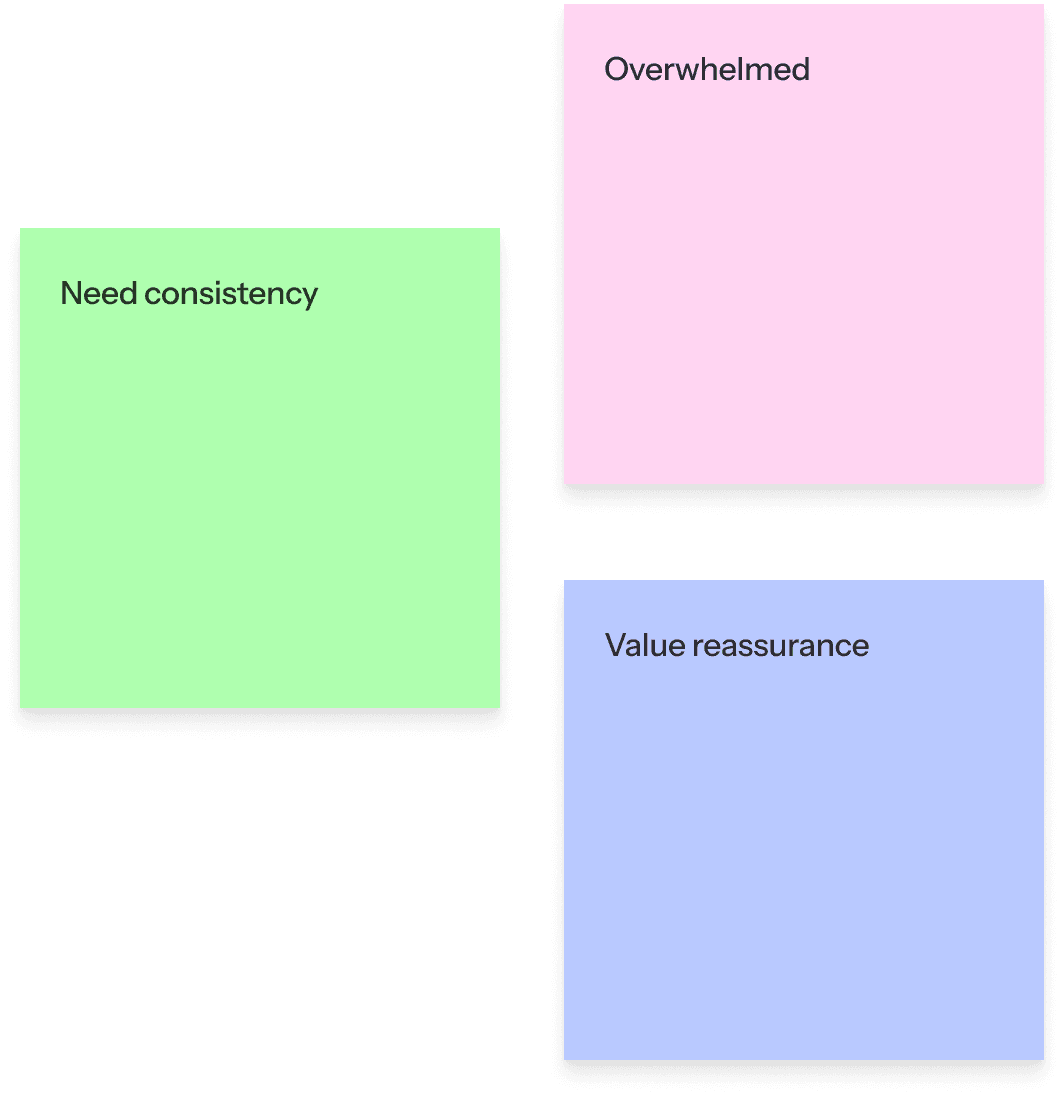

Simplified flows
Unified content
Advisor contact touchpoint
Mapping assumptions to actionable design decisions.
Validating design changes through usability testing.
Over a four-week sprint, our team tested the prototype with 10 participants across different user segments.. I observed sessions, documented behavioural patterns, and supported prototype adjustments in real time.
Key findings
Revisiting products mattered
Observation: Participants valued the ability to revisit products without losing progress, so that they could take time to compare options and reflect before making decisions.
Solution: Integrated a persistent saved products feature.
Educational content felt irrelevant
Observation: Users hesitated when exploring educational tools due to a lengthy process and they didn't immediately see how content was relevant to their financial goals.
Solution: Simplified onboarding and added in contextual guidance to help users understand how each step related to their financial goal.
Turning research into a story stakeholders could act on
After testing, I led the synthesis of design and research insights into a stakeholder-facing deck, capturing the refined flow, key usability findings, and design implications. This became the shared reference point for future iterations of the shopping experience.
Recommendations
Create seamless cross-channel experiences
Focus on continuity across digital and in-branch channels to make the process more digital and flexible.
Simplify onboarding and empower confidence
Integrate contextual guidance and simplified onboarding to reduce friction for users less confident with digital banking.
Support exploration without interruption
Allow users to explore multiple paths simultaneously such as comparing and saving products for later, or returning to previous steps without losing progress.
The recommendations I documented weren't just design suggestions, they were evidence-backed direction for how this experience could scale across TD's digital and in-branch channels.
What did I work on?
Post grad steering committee
Conducted user research with postgrads to discover financial needs and inform future experience strategies.
Post grad steering committee — Purpose
Understanding post grad needs to inform TD strategies, rewards, and advice model
TD needed to better understand the financial behaviours and needs of post grads, a segment with high lifetime value but low engagement with traditional banking products. The research I conducted directly informed cross-functional strategy and future product concepts.
Post grad steering committee — Approach
Facilitating open, generative discussions
I facilitated monthly two-hour sessions with 10–12 participants, intentionally recruited from a range of banks to avoid TD-specific bias. Each session focused on 4–5 targeted questions designed to surface real attitudes and not just surface-level preferences.
Sample questions I developed:
"What are your short, medium, and long-term goals?"
"Which banking rewards, tangible and intangible, do you value most? Why?"
"How could the bank support you in achieving your goals?"
"How do you decide which products or services to use? What resources would help you?"
Image blurred due to NDA
This synthesis revealed several key themes including:
Relevant tangible and intangible rewards influences retention
Post grads are motivated by both practical benefits (e.g., cashback, travel points) and emotional value (e.g., recognition, feeling appreciated). When rewards are relevant to their lifestyle and goals, this increases loyalty.
Banking can feel intimidating for those seeking advice
Many participants described feeling anxious or hesitant when approaching banks for advice.
Lack of clarity in rewards programs
Several post grads expressed confusion surrounding how points are calculated and redeemed. They described an overall lack of transparency that lowered trust and engagement, which emphasized the need for clear communication and simpler reward structures.
I translated findings across all sessions into two comprehensive 20+ slide presentations for stakeholders, structured to drive decisions, not just inform them. Each deck included direct participant quotes, visual theme summaries, and prioritized recommendations tied to business goals.
What did I work on?
Innovation challenge
Co-designed a top-five concept reimagining branches as inclusive, tech-enabled community spaces.
Innovation challenge — Overview
Reimagining branches in a mobile-first world
I participated in TD's Innovation Challenge where interns were divided into 15 teams and tasked to answer one question:
As TD continues to enhance its digital capabilities for customers, what does the future brick and mortar branch look like? What services and benefits could it offer to customers who will soon be able to do all banking from their phone?
Teams were evaluated on user impact, UX quality, innovation, and feasibility. The top five would present to a panel of senior executives.
Innovation challenge — Approach
Blending digital ease with human connection
Our secondary research and competitive analysis revealed a gap no competitor was addressing: while banks were racing to automate and digitize, customers, especially Gen Z, still craved human connection. Branches weren't failing because of what they offered. They were failing because they didn't feel worth visiting.
77%
of Gen Z customers prefer a more human touch in communications
74%
seek personal interaction to resolve issues
Branches shouldn’t just be places to transact, they should be places to connect.
Innovation challenge — Ideation
Exploring the solution space
Before getting to our final solution, we explored several ideas. Each responded to a real customer needs, but also fell short when evaluated against the challenge criteria.
Concepts we rejected (and why)
Advisory-first branches
High-value but limited to 'big decision' moments, not regular visits.
Digital education centres
Addressed a real need but too narrow in audience.
Community engagement and events-focused hubs
Aligned with TD values but disconnected from banking behaviour.
Innovation challenge — Solution
Introducing TD Tea House
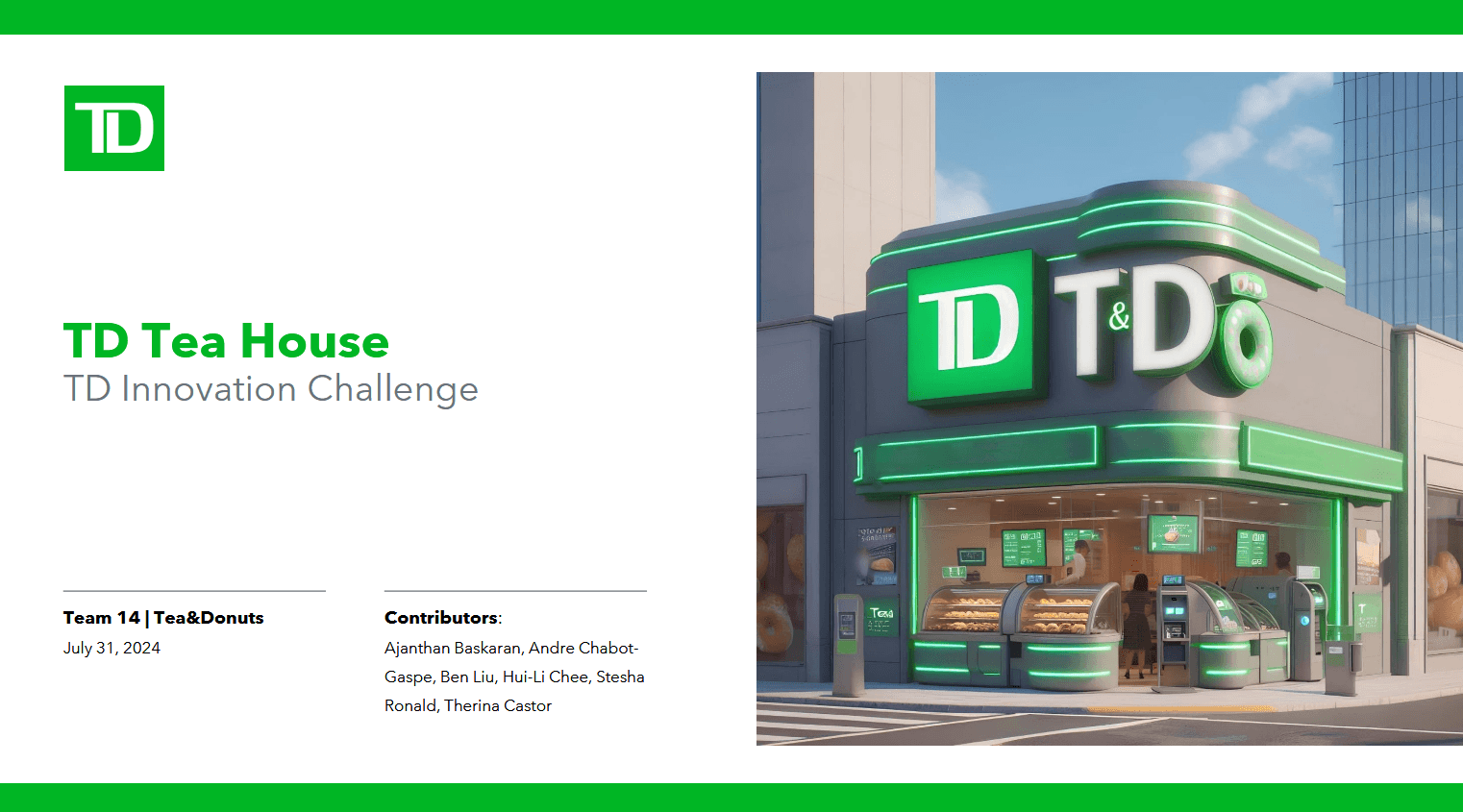
We reimagined the branch as a welcoming, tech-enabled community space , designed around trust, comfort, and meaningful interaction. Three features defined the concept:
A smoother arrival through app-based check-in
Customers check in via the TD app before or upon arrival, reducing wait uncertainty and letting advisors prepare in advance.
Context aware in-branch support
Opt-in proximity prompts surface advisor availability at the right moments, low-pressure and fully dismissible.
Community programming
Financial literacy workshops and events turn branches into places people actually want to visit, strengthening TD's community presence.
We grounded the concept in a three-phase rollout plan and a per-branch cost estimate of ~$190K, ensuring the pitch was credible as well as compelling.
Innovation challenge — Outcome
From concept to the top 5
I’m happy to say that our solution placed in the top 5 out of 15 teams and we presented our idea to the judges. I’m incredibly proud of what my team accomplished, not just for our placement, but also our idea's potential to redefine the customer banking experience!
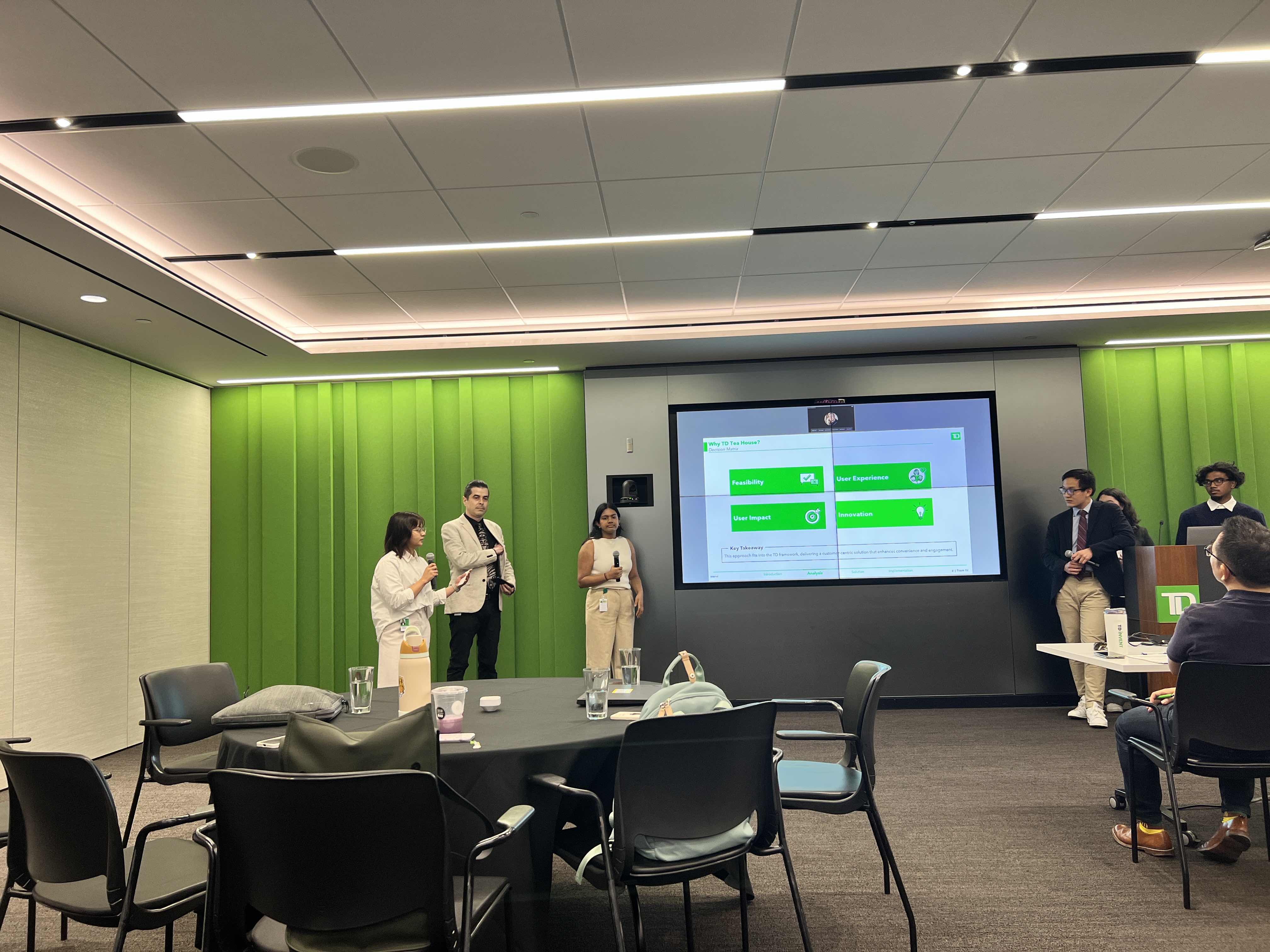
Pitching our concept to a panel of senior technology leaders.
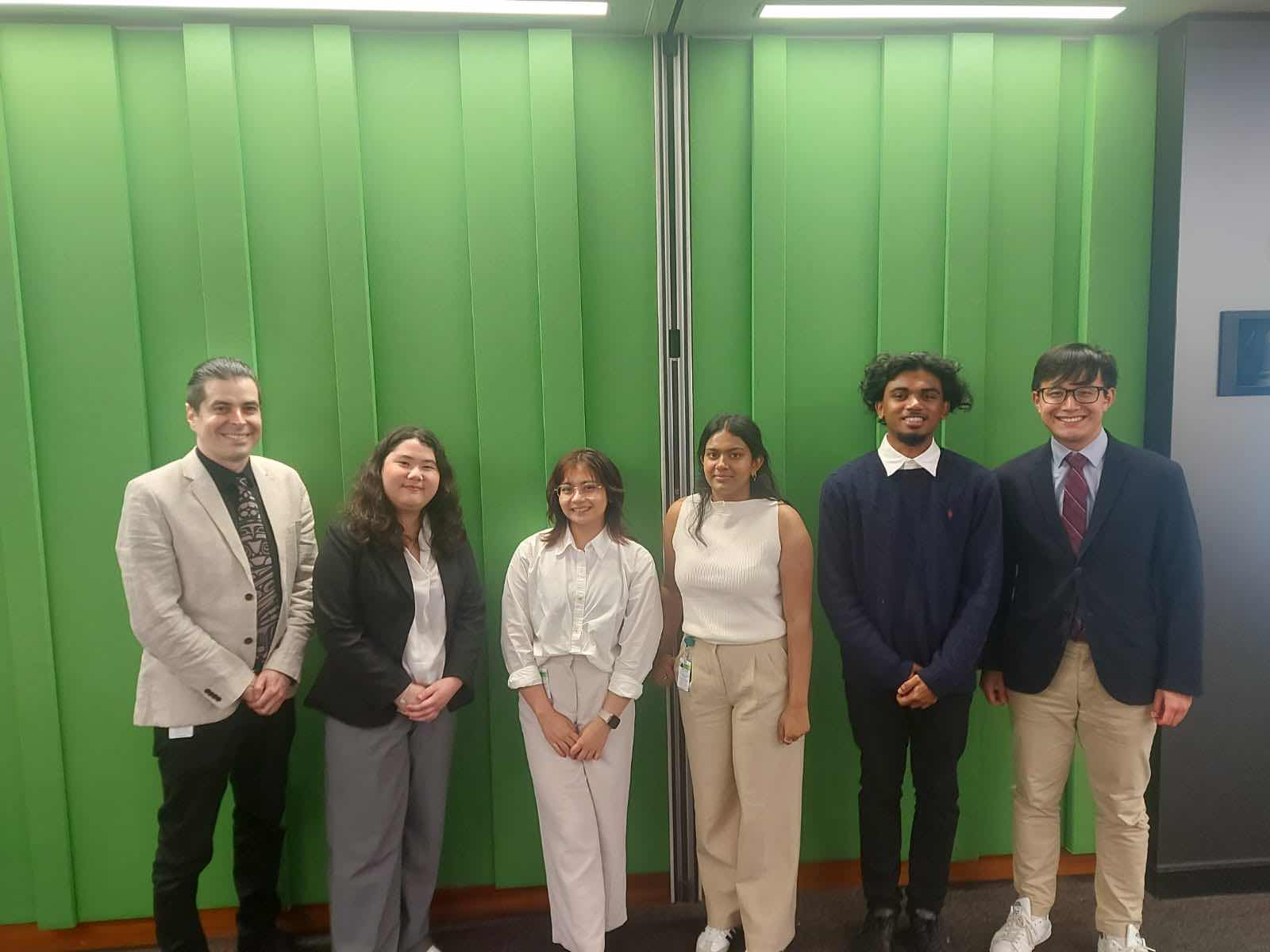
My team <3
What I learned
Challenges
Design and research aren't separate lanes
The most effective moments in this internship were when design decisions were directly traceable to a research finding. I came in thinking of these as complementary skills then I left thinking of them as one skill.
Flexibility is a design skill
I joined projects midway, shifted priorities mid-sprint, and adapted to feedback from multiple directions simultaneously. Learning to stay grounded in user needs while remaining genuinely flexible about approach was the most practical thing I took from this term.
Stakeholder communication is where design creates leverage
The work I'm most proud of from this internship isn't any single screen, it's the synthesis decks and the stakeholder presentations. That's where design decisions become strategy.
Personal reflection
💚 An unforgettable experience
With this being my first UX design internship, I couldn't have asked for a better experience. Getting the chance to work with a close team of designers, researchers, and strategists helped me to develop a deeper understanding of UX and HCD, and become more confident as a designer.
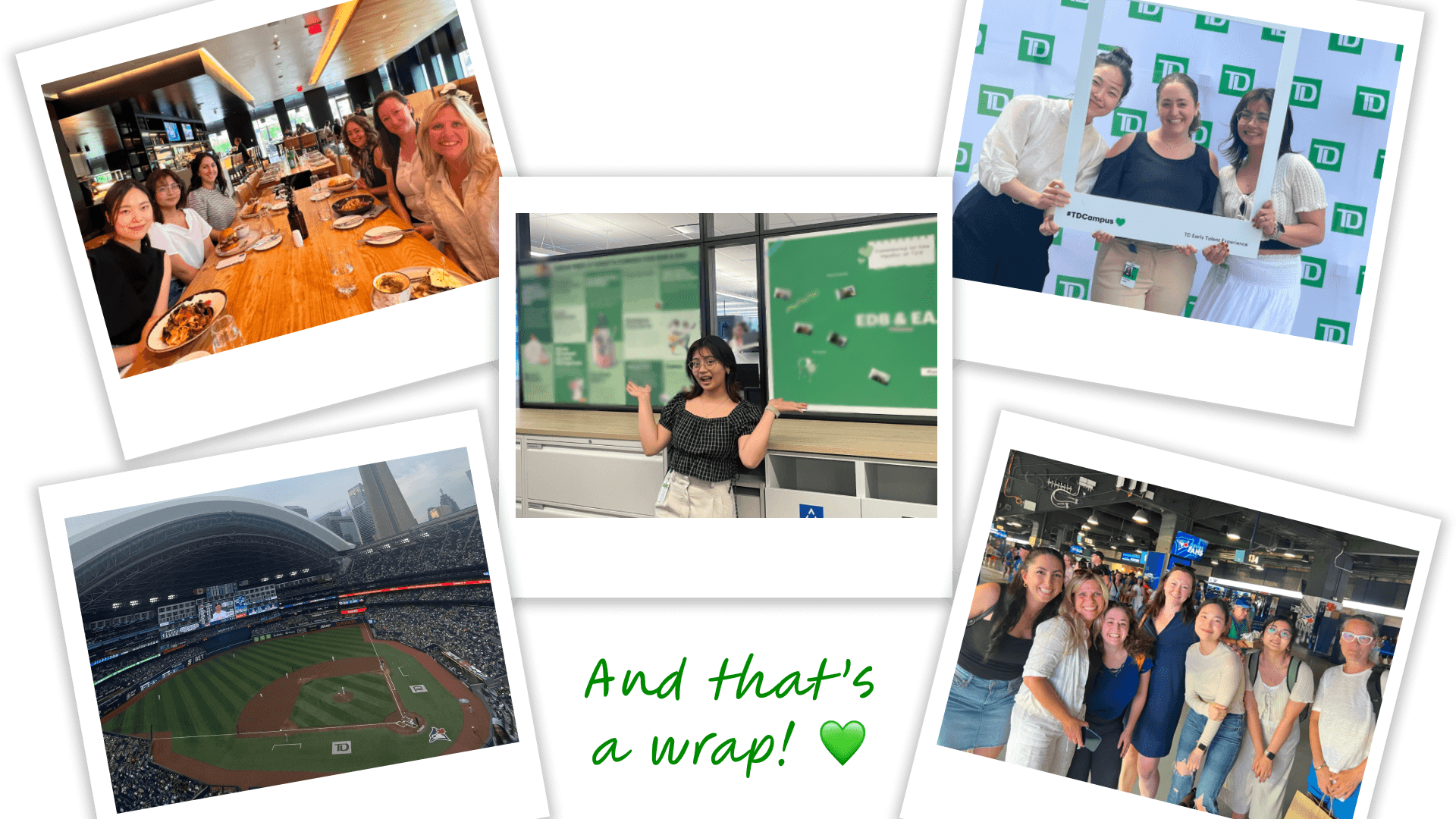
Redefining everyday banking through empathy
Thanks for checking out this case study! If you have any questions or want to know more, don't hesitate to contact me. While you're still here, please feel free to check out my other work or learn more about me. :)
TD Bank: Everyday Advice Journey (EAJ)
Shaped experiences for the next generation of TD customers
Overview
During summer 2024, I joined TD Bank’s EAJ Experience Strategy team as a UX Design Intern, to improve everyday banking for students, youth, postgrads, and newcomers, a segment that often finds banking intimidating, confusing, or irrelevant to their lives. I contributed across research, design, and strategy on three projects, each targeting a different aspect of the customer experience.
Role
UX Designer
Timeline
May - August 2024
Tools
Figma, FigJam
Note on confidentiality
Visuals are anonymized per NDA. Reach out to discuss the work in detail.
Projects at a glance
Designed for impact across banking journeys
Curious? Click a project to dive in.
What did I work on?
Cross-channel shopping experience
Redesigned how users explore and compare financial products across mobile and in-branch.
Cross-channel shopping experience — Purpose
Shift from transactional to value-driven banking
TD wanted to shift customer perception from transactional to value-drive, helping users explore, compare, and revisit financial products across digital and in-person channels, rather than treating each interaction as a one-off transaction.
Cross-channel shopping experience — Approach
Clarifying the problem space and aligning on a usable flow
I joined midway through the project, when the team had early concepts but no validated direction.
Through a review of previous research and existing prototype flows, I identified two key friction points:
Users treated educational tools as optional rather than helpful. They skipped them entirely.
Banking terminology during product comparison created cognitive overload, causing drop-off.
Rather than jumping to solutions, I first defined the design assumptions we'd need to validate to give the team a shared foundation before touching any screens.
1
Consistency builds confidence
Users expect to see consistent content across the mobile app and web experience.
2
Personalization keeps users engaged
Users would remain engaged if the experience offered relevant personalized content tailored to their goals and financial situations.
3
Accessible support builds trust
Users would feel supported knowing they could easily contact a TD advisor if they had questions or needed clarification.
Translated insights into tangible interactions
From there, I refined the prototype's interaction flow to encourage exploration over linear navigation, and made three targeted changes grounded in those assumptions.
Simplified flows
Unified content
Advisor contact touchpoint
Mapping assumptions to actionable design decisions.
Validating design changes through usability testing.
Over a four-week sprint, our team tested the prototype with 10 participants across different user segments.. I observed sessions, documented behavioural patterns, and supported prototype adjustments in real time.
Key findings
Revisiting products mattered
Observation: Participants valued the ability to revisit products without losing progress, so that they could take time to compare options and reflect before making decisions.
Solution: Integrated a persistent saved products feature.
Educational content felt irrelevant
Observation: Users hesitated when exploring educational tools due to a lengthy process and they didn't immediately see how content was relevant to their financial goals.
Solution: Simplified onboarding and added in contextual guidance to help users understand how each step related to their financial goal.
Turning research into a story stakeholders could act on
After testing, I led the synthesis of design and research insights into a stakeholder-facing deck, capturing the refined flow, key usability findings, and design implications. This became the shared reference point for future iterations of the shopping experience.
Recommendations
Create seamless cross-channel experiences
Focus on continuity across digital and in-branch channels to make the process more digital and flexible.
Simplify onboarding and empower confidence
Integrate contextual guidance and simplified onboarding to reduce friction for users less confident with digital banking.
Support exploration without interruption
Allow users to explore multiple paths simultaneously such as comparing and saving products for later, or returning to previous steps without losing progress.
The recommendations I documented weren't just design suggestions, they were evidence-backed direction for how this experience could scale across TD's digital and in-branch channels.
What did I work on?
Post grad steering committee
Conducted user research with postgrads to discover financial needs and inform future experience strategies.
Post grad steering committee — Purpose
Understanding post grad needs to inform TD strategies, rewards, and advice model
TD needed to better understand the financial behaviours and needs of post grads, a segment with high lifetime value but low engagement with traditional banking products. The research I conducted directly informed cross-functional strategy and future product concepts.
Post grad steering committee — Approach
Facilitating open, generative discussions
I facilitated monthly two-hour sessions with 10–12 participants, intentionally recruited from a range of banks to avoid TD-specific bias. Each session focused on 4–5 targeted questions designed to surface real attitudes and not just surface-level preferences.
Sample questions I developed:
"What are your short, medium, and long-term goals?"
"Which banking rewards, tangible and intangible, do you value most? Why?"
"How could the bank support you in achieving your goals?"
"How do you decide which products or services to use? What resources would help you?"
Image blurred due to NDA
This synthesis revealed several key themes including:
Relevant tangible and intangible rewards influences retention
Post grads are motivated by both practical benefits (e.g., cashback, travel points) and emotional value (e.g., recognition, feeling appreciated). When rewards are relevant to their lifestyle and goals, this increases loyalty.
Banking can feel intimidating for those seeking advice
Many participants described feeling anxious or hesitant when approaching banks for advice.
Lack of clarity in rewards programs
Several post grads expressed confusion surrounding how points are calculated and redeemed. They described an overall lack of transparency that lowered trust and engagement, which emphasized the need for clear communication and simpler reward structures.
I translated findings across all sessions into two comprehensive 20+ slide presentations for stakeholders, structured to drive decisions, not just inform them. Each deck included direct participant quotes, visual theme summaries, and prioritized recommendations tied to business goals.
What did I work on?
Innovation challenge
Co-designed a top-five concept reimagining branches as inclusive, tech-enabled community spaces.
Innovation challenge — Overview
Reimagining branches in a mobile-first world
I participated in TD's Innovation Challenge where interns were divided into 15 teams and tasked to answer one question:
As TD continues to enhance its digital capabilities for customers, what does the future brick and mortar branch look like? What services and benefits could it offer to customers who will soon be able to do all banking from their phone?
Teams were evaluated on user impact, UX quality, innovation, and feasibility. The top five would present to a panel of senior executives.
Innovation challenge — Approach
Blending digital ease with human connection
Our secondary research and competitive analysis revealed a gap no competitor was addressing: while banks were racing to automate and digitize, customers, especially Gen Z, still craved human connection. Branches weren't failing because of what they offered. They were failing because they didn't feel worth visiting.
77%
of Gen Z customers prefer a more human touch in communications
74%
seek personal interaction to resolve issues
Branches shouldn’t just be places to transact, they should be places to connect.
Innovation challenge — Ideation
Exploring the solution space
Before getting to our final solution, we explored several ideas. Each responded to a real customer needs, but also fell short when evaluated against the challenge criteria.
Concepts we rejected (and why)
Advisory-first branches
High-value but limited to 'big decision' moments, not regular visits.
Digital education centres
Addressed a real need but too narrow in audience.
Community engagement and events-focused hubs
Aligned with TD values but disconnected from banking behaviour.
Innovation challenge — Solution
Introducing TD Tea House
We reimagined the branch as a welcoming, tech-enabled community space , designed around trust, comfort, and meaningful interaction. Three features defined the concept:
A smoother arrival through app-based check-in
Customers check in via the TD app before or upon arrival, reducing wait uncertainty and letting advisors prepare in advance.
Context aware in-branch support
Opt-in proximity prompts surface advisor availability at the right moments, low-pressure and fully dismissible.
Community programming
Financial literacy workshops and events turn branches into places people actually want to visit, strengthening TD's community presence.
We grounded the concept in a three-phase rollout plan and a per-branch cost estimate of ~$190K, ensuring the pitch was credible as well as compelling.
Innovation challenge — Outcome
From concept to the top 5
I’m happy to say that our solution placed in the top 5 out of 15 teams and we presented our idea to the judges. I’m incredibly proud of what my team accomplished, not just for our placement, but also our idea's potential to redefine the customer banking experience!
Pitching our concept to a panel of senior technology leaders.
My team <3
What I learned
Challenges
Design and research aren't separate lanes
The most effective moments in this internship were when design decisions were directly traceable to a research finding. I came in thinking of these as complementary skills then I left thinking of them as one skill.
Flexibility is a design skill
I joined projects midway, shifted priorities mid-sprint, and adapted to feedback from multiple directions simultaneously. Learning to stay grounded in user needs while remaining genuinely flexible about approach was the most practical thing I took from this term.
Stakeholder communication is where design creates leverage
The work I'm most proud of from this internship isn't any single screen, it's the synthesis decks and the stakeholder presentations. That's where design decisions become strategy.
Personal reflection
💚 An unforgettable experience
With this being my first UX design internship, I couldn't have asked for a better experience. Getting the chance to work with a close team of designers, researchers, and strategists helped me to develop a deeper understanding of UX and HCD, and become more confident as a designer.
Redefining everyday banking through empathy
Thanks for checking out this case study! If you have any questions or want to know more, don't hesitate to contact me. While you're still here, please feel free to check out my other work or learn more about me. :)
TD Bank: Everyday Advice Journey (EAJ)
Shaped experiences for the next generation of TD customers
Overview
During summer 2024, I joined TD Bank’s EAJ Experience Strategy team as a UX Design Intern, to improve everyday banking for students, youth, postgrads, and newcomers, a segment that often finds banking intimidating, confusing, or irrelevant to their lives. I contributed across research, design, and strategy on three projects, each targeting a different aspect of the customer experience.
Role
UX Designer
Timeline
May - August 2024
Tools
Figma, FigJam
Note on confidentiality
Visuals are anonymized per NDA. Reach out to discuss the work in detail.
Projects at a glance
Designed for impact across banking journeys
Curious? Click a project to dive in.
What did I work on?
Cross-channel shopping experience
Redesigned how users explore and compare financial products across mobile and in-branch.
Cross-channel shopping experience — Purpose
Shift from transactional to value-driven banking
TD wanted to shift customer perception from transactional to value-drive, helping users explore, compare, and revisit financial products across digital and in-person channels, rather than treating each interaction as a one-off transaction.
Cross-channel shopping experience — Approach
Clarifying the problem space and aligning on a usable flow
I joined midway through the project, when the team had early concepts but no validated direction.
Through a review of previous research and existing prototype flows, I identified two key friction points:
Users treated educational tools as optional rather than helpful. They skipped them entirely.
Banking terminology during product comparison created cognitive overload, causing drop-off.
Rather than jumping to solutions, I first defined the design assumptions we'd need to validate to give the team a shared foundation before touching any screens.
1
Consistency builds confidence
Users expect to see consistent content across the mobile app and web experience.
2
Personalization keeps users engaged
Users would remain engaged if the experience offered relevant personalized content tailored to their goals and financial situations.
3
Accessible support builds trust
Users would feel supported knowing they could easily contact a TD advisor if they had questions or needed clarification.
Translated insights into tangible interactions
From there, I refined the prototype's interaction flow to encourage exploration over linear navigation, and made three targeted changes grounded in those assumptions.
Simplified flows
Unified content
Advisor contact touchpoint
Mapping assumptions to actionable design decisions.
Validating design changes through usability testing.
Over a four-week sprint, our team tested the prototype with 10 participants across different user segments.. I observed sessions, documented behavioural patterns, and supported prototype adjustments in real time.
Key findings
Revisiting products mattered
Observation: Participants valued the ability to revisit products without losing progress, so that they could take time to compare options and reflect before making decisions.
Solution: Integrated a persistent saved products feature.
Educational content felt irrelevant
Observation: Users hesitated when exploring educational tools due to a lengthy process and they didn't immediately see how content was relevant to their financial goals.
Solution: Simplified onboarding and added in contextual guidance to help users understand how each step related to their financial goal.
Turning research into a story stakeholders could act on
After testing, I led the synthesis of design and research insights into a stakeholder-facing deck, capturing the refined flow, key usability findings, and design implications. This became the shared reference point for future iterations of the shopping experience.
Recommendations
Create seamless cross-channel experiences
Focus on continuity across digital and in-branch channels to make the process more digital and flexible.
Simplify onboarding and empower confidence
Integrate contextual guidance and simplified onboarding to reduce friction for users less confident with digital banking.
Support exploration without interruption
Allow users to explore multiple paths simultaneously such as comparing and saving products for later, or returning to previous steps without losing progress.
The recommendations I documented weren't just design suggestions, they were evidence-backed direction for how this experience could scale across TD's digital and in-branch channels.
What did I work on?
Post grad steering committee
Conducted user research with postgrads to discover financial needs and inform future experience strategies.
Post grad steering committee — Purpose
Understanding post grad needs to inform TD strategies, rewards, and advice model
TD needed to better understand the financial behaviours and needs of post grads, a segment with high lifetime value but low engagement with traditional banking products. The research I conducted directly informed cross-functional strategy and future product concepts.
Post grad steering committee — Approach
Facilitating open, generative discussions
I facilitated monthly two-hour sessions with 10–12 participants, intentionally recruited from a range of banks to avoid TD-specific bias. Each session focused on 4–5 targeted questions designed to surface real attitudes and not just surface-level preferences.
Sample questions I developed:
"What are your short, medium, and long-term goals?"
"Which banking rewards, tangible and intangible, do you value most? Why?"
"How could the bank support you in achieving your goals?"
"How do you decide which products or services to use? What resources would help you?"
Image blurred due to NDA
This synthesis revealed several key themes including:
Relevant tangible and intangible rewards influences retention
Post grads are motivated by both practical benefits (e.g., cashback, travel points) and emotional value (e.g., recognition, feeling appreciated). When rewards are relevant to their lifestyle and goals, this increases loyalty.
Banking can feel intimidating for those seeking advice
Many participants described feeling anxious or hesitant when approaching banks for advice.
Lack of clarity in rewards programs
Several post grads expressed confusion surrounding how points are calculated and redeemed. They described an overall lack of transparency that lowered trust and engagement, which emphasized the need for clear communication and simpler reward structures.
I translated findings across all sessions into two comprehensive 20+ slide presentations for stakeholders, structured to drive decisions, not just inform them. Each deck included direct participant quotes, visual theme summaries, and prioritized recommendations tied to business goals.
What did I work on?
Innovation challenge
Co-designed a top-five concept reimagining branches as inclusive, tech-enabled community spaces.
Innovation challenge — Overview
Reimagining branches in a mobile-first world
I participated in TD's Innovation Challenge where interns were divided into 15 teams and tasked to answer one question:
As TD continues to enhance its digital capabilities for customers, what does the future brick and mortar branch look like? What services and benefits could it offer to customers who will soon be able to do all banking from their phone?
Teams were evaluated on user impact, UX quality, innovation, and feasibility. The top five would present to a panel of senior executives.
Innovation challenge — Approach
Blending digital ease with human connection
Our secondary research and competitive analysis revealed a gap no competitor was addressing: while banks were racing to automate and digitize, customers, especially Gen Z, still craved human connection. Branches weren't failing because of what they offered. They were failing because they didn't feel worth visiting.
77%
of Gen Z customers prefer a more human touch in communications
74%
seek personal interaction to resolve issues
Branches shouldn’t just be places to transact, they should be places to connect.
Innovation challenge — Ideation
Exploring the solution space
Before getting to our final solution, we explored several ideas. Each responded to a real customer needs, but also fell short when evaluated against the challenge criteria.
Concepts we rejected (and why)
Advisory-first branches
High-value but limited to 'big decision' moments, not regular visits.
Digital education centres
Addressed a real need but too narrow in audience.
Community engagement and events-focused hubs
Aligned with TD values but disconnected from banking behaviour.
Innovation challenge — Solution
Introducing TD Tea House
We reimagined the branch as a welcoming, tech-enabled community space , designed around trust, comfort, and meaningful interaction. Three features defined the concept:
A smoother arrival through app-based check-in
Customers check in via the TD app before or upon arrival, reducing wait uncertainty and letting advisors prepare in advance.
Context aware in-branch support
Opt-in proximity prompts surface advisor availability at the right moments, low-pressure and fully dismissible.
Community programming
Financial literacy workshops and events turn branches into places people actually want to visit, strengthening TD's community presence.
We grounded the concept in a three-phase rollout plan and a per-branch cost estimate of ~$190K, ensuring the pitch was credible as well as compelling.
Innovation challenge — Outcome
From concept to the top 5
I’m happy to say that our solution placed in the top 5 out of 15 teams and we presented our idea to the judges. I’m incredibly proud of what my team accomplished, not just for our placement, but also our idea's potential to redefine the customer banking experience!
Pitching our concept to a panel of senior technology leaders.
My team <3
What I learned
Challenges
Design and research aren't separate lanes
The most effective moments in this internship were when design decisions were directly traceable to a research finding. I came in thinking of these as complementary skills then I left thinking of them as one skill.
Flexibility is a design skill
I joined projects midway, shifted priorities mid-sprint, and adapted to feedback from multiple directions simultaneously. Learning to stay grounded in user needs while remaining genuinely flexible about approach was the most practical thing I took from this term.
Stakeholder communication is where design creates leverage
The work I'm most proud of from this internship isn't any single screen, it's the synthesis decks and the stakeholder presentations. That's where design decisions become strategy.
Personal reflection
💚 An unforgettable experience
With this being my first UX design internship, I couldn't have asked for a better experience. Getting the chance to work with a close team of designers, researchers, and strategists helped me to develop a deeper understanding of UX and HCD, and become more confident as a designer.
Redefining everyday banking through empathy
Thanks for checking out this case study! If you have any questions or want to know more, don't hesitate to contact me. While you're still here, please feel free to check out my other work or learn more about me. :)